Matte White vs Fiberglass vs PVC Projection Screen Fabrics
---
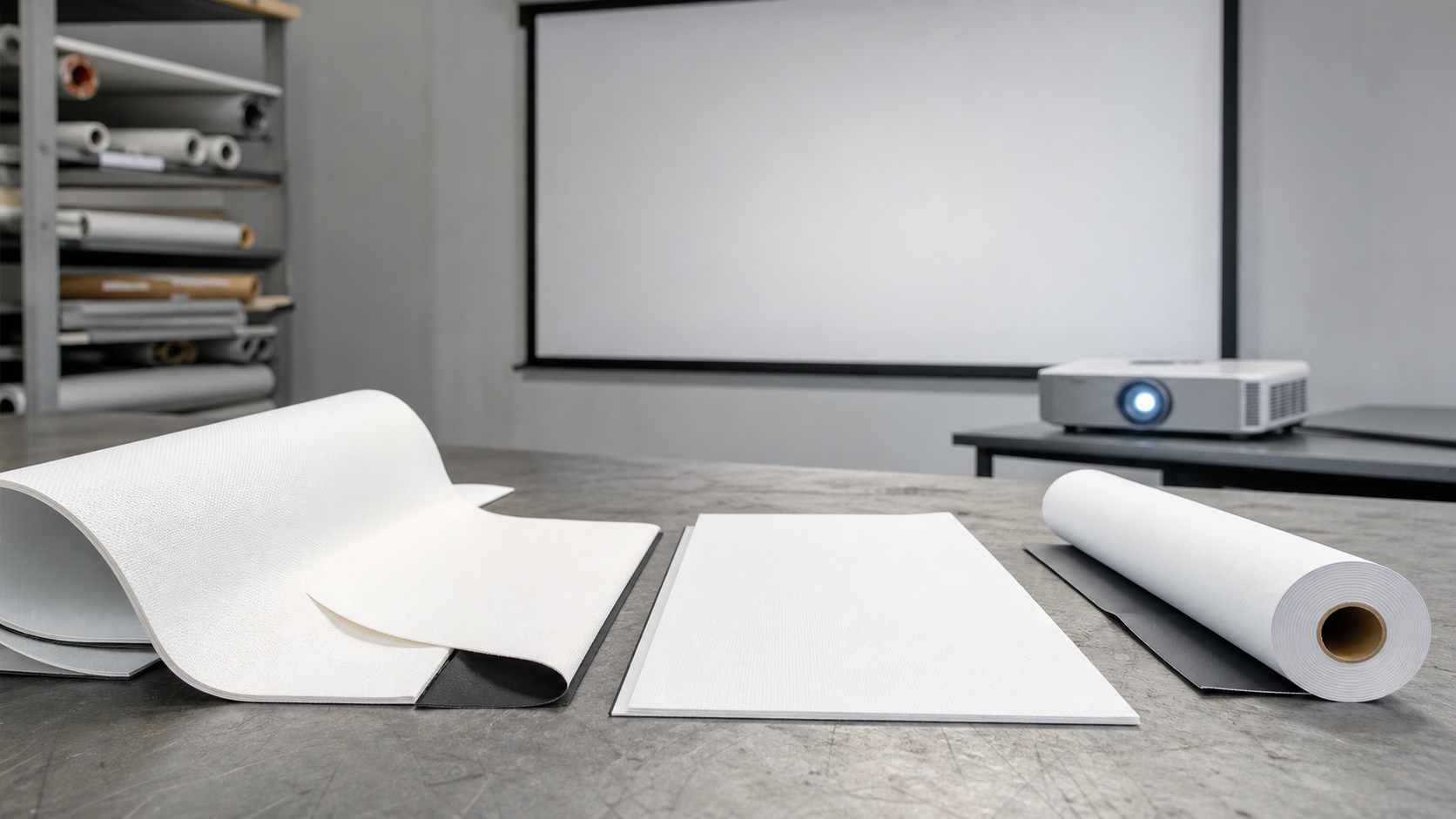
“White screen,” “fiberglass” and “PVC” describe different aspects of a projection surface. Matte white is usually a visual or optical direction. Fiberglass refers to a supporting structure used in some fabrics. PVC may refer to a soft, reinforced or coated construction. The actual viewing result depends on the full material build, finish, frame or housing, projector and room.
In This Guide
Quick Answer
Start with the room and projector, then compare the material construction that can deliver the required flatness, viewing width, handling and maintenance. Matte white is often considered for controlled rooms and broad seating. Fiberglass-backed material may be useful where a stable surface and predictable handling are important. PVC constructions can support different surface finishes and product forms, but the exact texture, backing and compatibility must be confirmed by model.
MGF’s Screen Materials Hub contains related comparisons. The material names in a quotation should match the approved sample and the product’s controlled technical record.
Who This Guide Is For
This guide is for AV integrators, distributors, contractors and project buyers who need a documented selection and project-planning path for this topic before requesting a quotation.
Material Names Are Not Complete Specifications
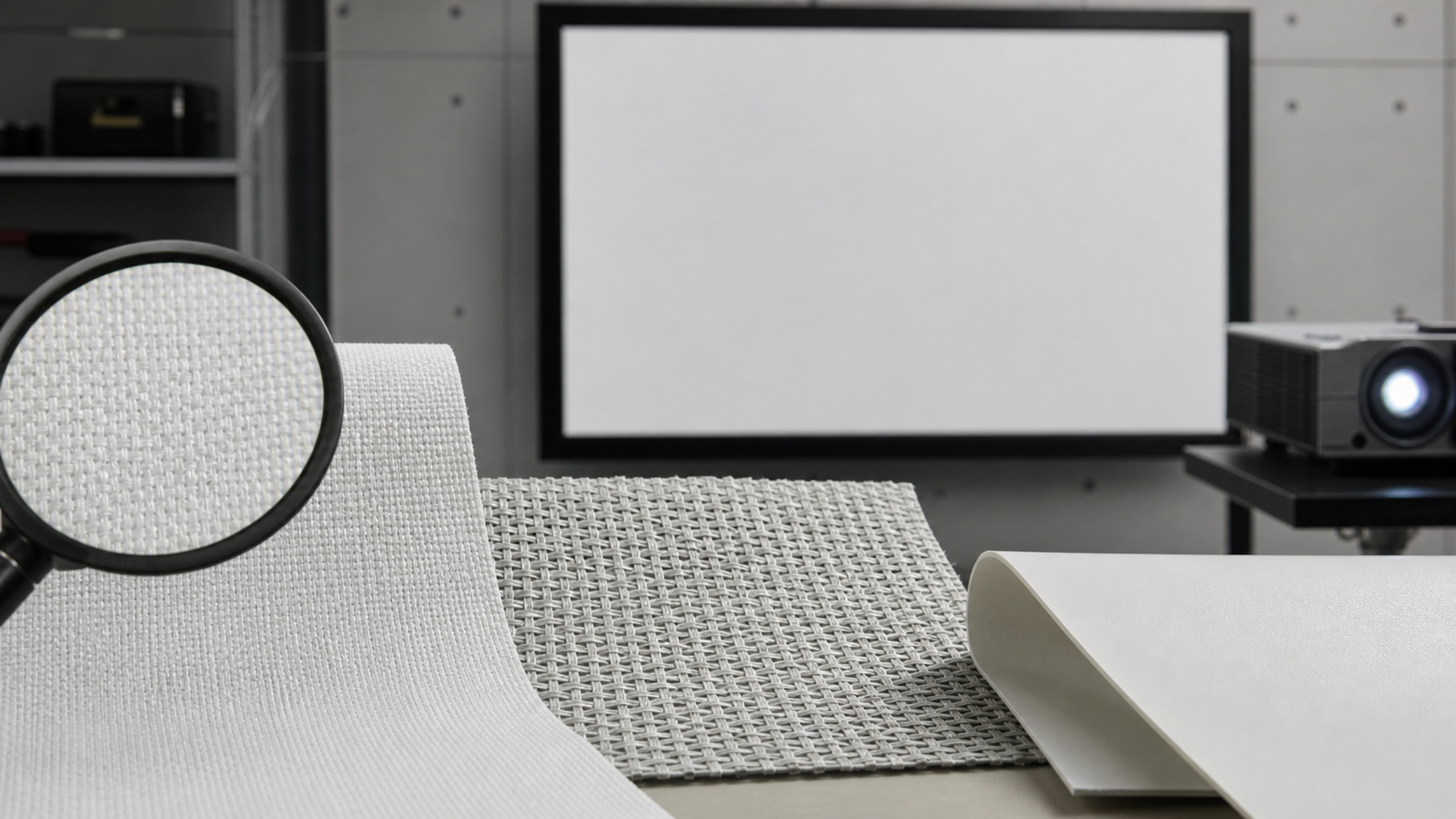
Two products can both be called “white PVC” and still differ in surface finish, backing, thickness, flexibility, edge treatment and approved screen structure. A fiberglass material can also be supplied with different optical surfaces. Avoid ranking the three words as if they were a universal quality ladder.
Instead, ask five questions: What is the surface finish? What is the backing or reinforcement? Which frame or housing is compatible? Which projector geometry is intended? How will the material be packed, cleaned and replaced?
Comparison Table
| Planning dimension | Matte white direction | Fiberglass construction | PVC construction |
|---|---|---|---|
| Main description | Optical surface direction | Reinforced or supported fabric structure | Polymer-based surface or backing family |
| Typical decision | Wide viewing and natural presentation | Handling, stability and structural support | Finish, flexibility and product-family compatibility |
| Project fit | Controlled classrooms, meeting rooms and theaters | Fixed or retractable systems depending on model | Fixed, retractable or specialty systems depending on model |
| Main risk | Weak ambient-light rejection in bright rooms | Assuming every fiberglass surface looks the same | Treating every PVC finish as interchangeable |
| Approval method | Projector and seating test | Sample plus attachment/flatness check | Sample plus structure and cleaning check |
This table is a selection framework, not a performance specification.
Matte White: When Wide Viewing Matters
A matte white direction is often considered when the room can be darkened and viewers sit across a broad horizontal angle. It can provide a straightforward reference surface for text, presentations and cinema content. The trade-off is that uncontrolled light may wash out the image. Use the ALR vs matte white guide to evaluate room-light strategy before changing material.
For a large room, record the center and side-seat result. A surface that looks comfortable for the presenter may appear less uniform at the edge of a classroom or conference table.
Fiberglass: When Structure and Handling Matter
Fiberglass reinforcement can support a stable handling and tensioning approach in some screen fabrics. The useful questions are whether the material is approved for the selected frame or roller, how it attaches, how it is stored and how the surface is protected from creasing.
Do not assume “fiberglass” means rigid, wrinkle-proof or suitable for every retractable mechanism. Confirm the exact surface, backing, roll direction and installation method. For a fixed frame, review wall flatness and the frame’s tensioning sequence. For a motorized screen, confirm rolling compatibility and the bottom-bar design.
PVC: When Finish and Product Family Need Careful Matching
PVC can describe a soft projection fabric, a reinforced construction or a material with an optical coating. It may be offered in white, grey, ALR or other directions. The label is therefore a starting point, not a final choice.
Request the material code, finish, backing, thickness if controlled, recommended projection direction and cleaning instructions. If the project uses a short-throw or UST projector, the PVC finish must be evaluated with the actual angle. The short-throw material guide explains the pairing questions.
Match the Fabric to the Structure
Fixed frame screens prioritize a flat, tensioned image plane and serviceable edge attachment. Electric and tab-tensioned screens add rolling, side tension, bottom bar and housing constraints. Portable screens add folds, packing, legs and repeated handling. A fabric that performs well in a fixed frame may not be approved for a motorized roller or portable case.
Use MGF’s fixed frame range or electric screen range as the product starting point, then ask which material options are available for the exact series and size.
Material Approval Checklist
- material name, code and revision;
- optical finish and intended projection direction;
- projector type, throw ratio and lens position;
- visible image size, aspect ratio and border;
- nearest and side viewing positions;
- frame, housing or tensioning compatibility;
- cleaning, storage and replacement method;
- sample test conditions and approval owner;
- documents that connect sample, quotation, drawing and purchase order.
MGF Product Direction
MGF can compare suitable product directions once the project brief confirms visible image size, aspect ratio, projector geometry, material direction, mounting condition, control requirements, quantity and destination market. The final quotation should identify the exact model, compatible material, drawing and approval information rather than treating a generic guide as a product specification.
Project / OEM Checklist
- visible image width, height and aspect ratio;
- projector model, lens position and image geometry;
- room or venue use, seating and ambient-light condition;
- proposed material, structure, mounting and service access;
- power, control and installation responsibility where relevant;
- required quantity, destination market, drawing revision and approval owner.
Continue Your Project Planning
- Screen Materials Guides
- Fixed Frame Projection Screens
- Home Theater Applications
- Factory & Production
- Acoustic Transparent Screen Guide
- Projection Screen Gain and Viewing Angle Guide
- Contact MGF Screens
FAQ
Is matte white always the safest option?
It is often a practical starting point for controlled rooms and wide seating, but bright or directional light may require another material direction.
Does fiberglass eliminate waves?
Not automatically. Flatness depends on the complete fabric, attachment, frame or tensioning system and installation.
Is PVC suitable for UST projection?
Only when the exact PVC surface is approved for the projector geometry. The material family name alone is not enough.
Can I replace one fabric with another in the same housing?
Do not assume so. Confirm dimensions, rolling behavior, attachment, weight and controller or bottom-bar compatibility.
Request a Material Comparison
Send the room type, projector, image size, seating width, installation method and preferred material direction through the Contact page. MGF can then identify the applicable material family and the sample or technical confirmation needed.