Fixed Frame vs Motorized Screen for a Home Theater
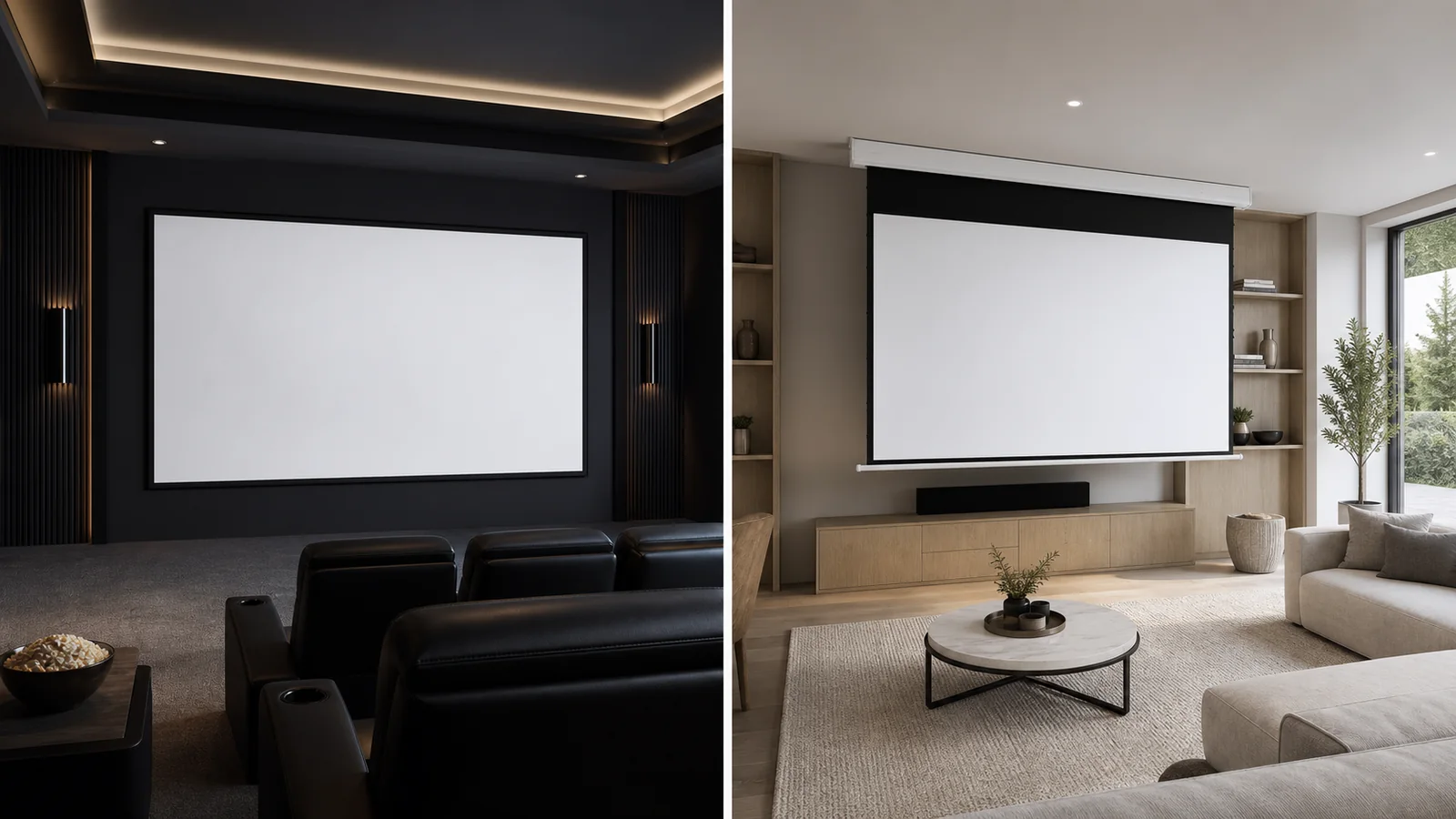
Choose a fixed-frame projection screen when the room has a permanent projection wall and surface planarity is the main priority. Choose a motorized screen when the surface must disappear to reveal a television, window, artwork or multipurpose wall. If you need both retractability and stronger surface control, compare a tab-tensioned motorized screen.
The screen type should follow the room, projector and material—not appearance alone. A fixed frame is mechanically simpler and continuously tensioned. A motorized screen integrates more easily into a shared living space but adds a roller, motor, controls and service requirements.
In This Guide
Quick Comparison
| Decision factor | Fixed-frame screen | Motorized screen |
|---|---|---|
| Visibility | Always visible | Retracts when not in use |
| Surface support | Tensioned around a rigid perimeter | Roller and bottom bar; side tension optional |
| Best room | Dedicated cinema or permanent projection wall | Living room or multipurpose space |
| Power | Not required | Required |
| Controls | None | Model-dependent switch, remote or integration |
| Installation | Frame assembly and wall mounting | Housing, structure, power, controls and access |
| Service complexity | Lower | Higher |
| Material flexibility | Broad, subject to frame/projector design | Must be compatible with rolling mechanism |
MGF’s home theater application shows the main screen formats relevant to residential projection.
When a Fixed-Frame Screen Is the Better Choice
The room is dedicated to projection
If the screen wall has no other daily function, leaving the surface installed removes deployment steps and moving components. The image area remains in the same position for projector alignment and speaker planning.
Surface planarity is a priority
A fixed frame tensions the material around the perimeter. This is useful for detailed images and for projection systems that reveal small surface irregularities. Correct assembly and even tension are still important.
Speakers need to sit behind the image
Selected acoustically transparent materials allow speaker placement behind the screen, supporting cinema-style audio layout. The room designer must evaluate image texture, seating distance, speaker position and acoustic behavior as a complete system.
The projector is ultra-short-throw
UST projection is highly sensitive to surface geometry. A compatible rigidly installed screen and directional material are often considered for living-room “laser TV” systems. Verify the exact projector, material orientation and frame combination; not every ALR surface is designed for UST.
MGF’s fixed-frame projection screen category includes full-screen, ultra-narrow-bezel, economic, standard and curved formats for comparison.
When a Motorized Screen Is the Better Choice
The room serves more than one purpose
A living room may use the wall for a television, window, cabinet or artwork. A retractable screen allows the projection surface to appear only when needed.
Interior design requires concealed equipment
An in-ceiling electric projection screen can hide the housing above the finished ceiling. This creates a clean appearance but requires early coordination with structure, power, ceiling openings, black drop and service access.
The screen should join a smart-home workflow
Selected motorized configurations may support remote, trigger, voice or app-based control. Confirm the exact interface before ordering and provide a local fallback control. A marketing term such as “smart control” is not a complete integration specification.
The projection wall cannot remain occupied
Retractability can be more valuable than the theoretical advantage of a fixed surface. The best screen is the one the room can support without compromising everyday use.
Browse MGF’s electric projection screens to compare surface-mounted and concealed formats.
The Middle Option: Tab-Tensioned Motorized Screens
A tab-tension system adds lateral support to a retractable surface. It is relevant when the screen must disappear but image-surface planarity has higher priority than a standard roll-down screen can satisfy.
Tab tension does not turn a retractable screen into a rigid fixed frame, and it does not guarantee a perfectly flat surface in every environment. Material, size, installation alignment and tension adjustment remain important.
Review the tab-tension projection screen range and the companion comparison on tab-tensioned versus non-tensioned screens after it is published.
Seven Factors to Decide
1. Dedicated Room or Shared Living Space
List what occupies the wall when projection is off. If the answer is “nothing,” a fixed frame deserves strong consideration. If a television, window or interior feature must remain usable, motorized may be the practical solution.
Also consider children, pets and traffic near the screen. A permanently exposed surface may require more protection in an active family room.
2. Projector Throw Type
Record whether the projector is standard throw, short throw or ultra-short throw. The angle at which light reaches the screen affects sensitivity to geometry and material direction.
For UST, do not pair the projector with a generic white or generic ALR screen based only on product category. Confirm the specific material is intended for the throw geometry.
3. Ambient Light
The strongest improvement is often controlling unwanted light at the screen. Curtains, lighting zones and projector placement should be considered before expecting a material to solve the room.
Evaluate material for:
- projector type and calibrated brightness;
- image size;
- direction of ambient light;
- seating width;
- color and brightness uniformity;
- visible texture, hotspotting or sparkle;
- acoustic requirements.
MGF’s supplied matrix lists PVC soft white, selected ALR, grey metallic and acoustically transparent options across different fixed-frame and tab-tension models. Compatibility and current availability must be confirmed by configuration.
4. Surface Planarity
Fixed frames use perimeter tension and are the straightforward choice when the surface stays visible. Standard motorized screens rely mainly on the roller and bottom bar. Tab-tensioned motorized screens add lateral force.
If planarity is a purchase requirement, define how the screen will be viewed and inspected instead of using only the word “flat.” Compare samples or established configurations at the intended size and projector throw.
5. Installation and Architecture
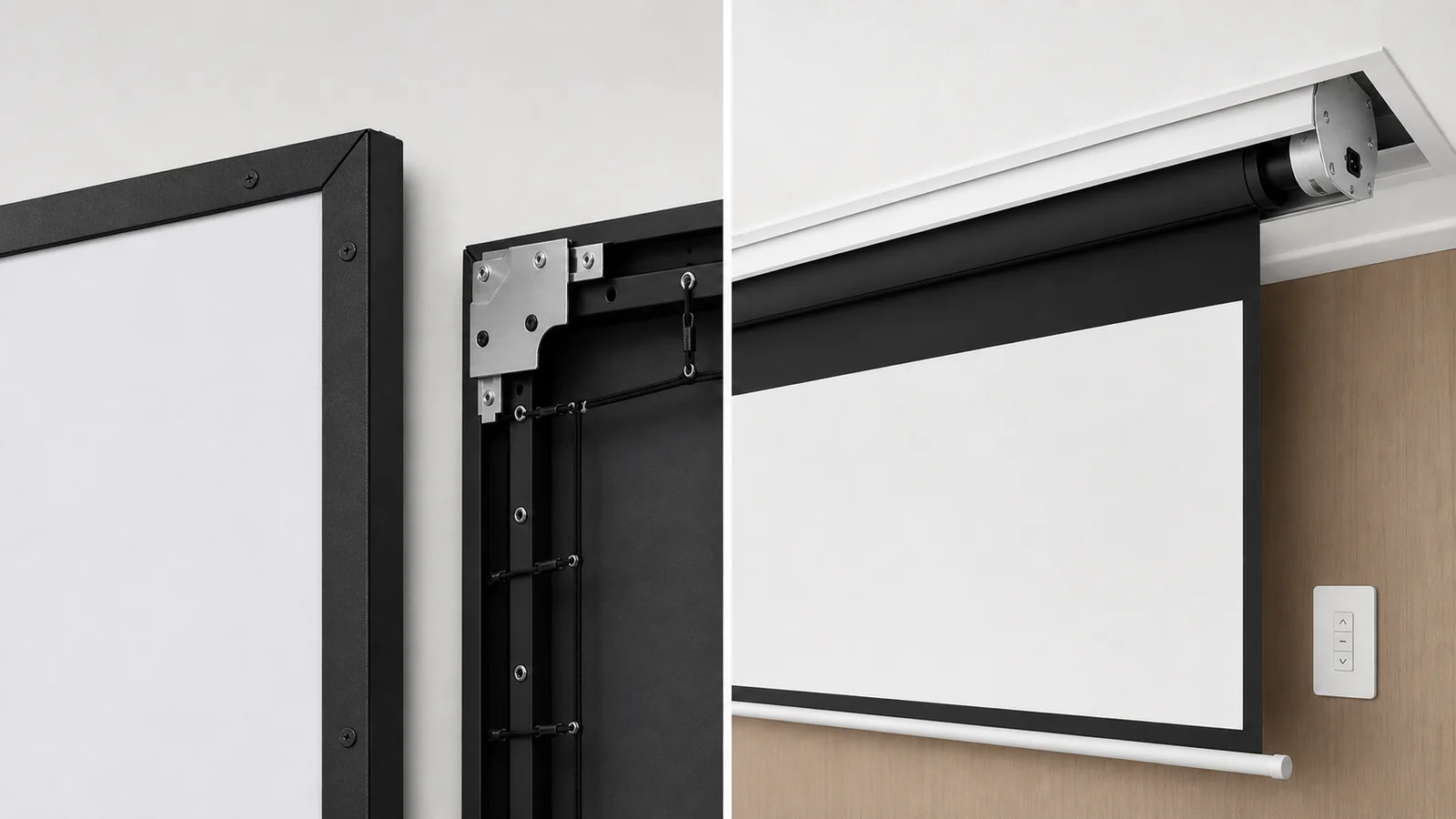
A fixed frame needs a flat mounting wall, accurate assembly and enough clearance around the complete frame. Confirm that it can be brought into the room or assembled on site.
A motorized screen needs:
- structural wall or ceiling support;
- power and controls;
- clear deployment path;
- correct black drop and image position;
- projector-beam clearance;
- future access to the motor and controller.
For recessed products, approve the technical drawing before ceiling construction.
6. Audio Layout
If speakers sit behind the image, specify an acoustically transparent surface and design the speaker distance, toe-in, equalization and viewing distance accordingly. If speakers sit beside or below the screen, check that a wider frame or motorized housing does not conflict with placement.
Do not assume that any perforated or woven material is interchangeable. Image and acoustic results differ by construction and installation.
7. Budget and Lifecycle
Compare complete installed cost:
- screen and selected material;
- frame assembly or motor/control system;
- wall or ceiling preparation;
- electrical and integration work;
- installation and commissioning;
- future access, parts and maintenance.
A fixed frame can be mechanically simpler. A motorized screen may justify additional cost by preserving the room’s non-cinema functions. The decision is about room value, not only hardware price.
MGF Fixed-Frame Options to Compare
Full-screen fixed frame
The full-screen fixed-frame projection screen uses an internal aluminum frame and a borderless visual treatment. MGF’s supplied product matrix lists common 4:3 and 16:9 configurations, with current size and material options to be confirmed.
Ultra-narrow-bezel fixed frame
The ultra-narrow-bezel fixed-frame screen is listed with a 10 mm bezel in the supplied product information. It is relevant where buyers want a slim visible border and fixed tension.
Standard and economic fixed frame
These formats use wider visible frames and spring-based tensioning in the supplied matrix. They may suit dedicated cinemas, meeting rooms or education spaces where function and value have priority over a borderless look.
MGF Motorized Options to Compare
- standard electric for a straightforward wall or ceiling installation;
- aluminum-casing electric for a more design-led surface-mounted housing;
- in-ceiling electric for concealed installation;
- in-ceiling or surface-mounted tab-tension for retractability with additional surface control;
- floor-rising tab-tension for selected furniture-integrated layouts.
Do not copy one material across all formats. A surface must be optically and mechanically compatible with the selected product.
A Simple Decision Path
- Can the screen remain visible? If yes, evaluate fixed frame first.
- Must the wall serve another purpose? If yes, evaluate motorized.
- Is retractability required and planarity critical? Add tab tension to the comparison.
- Is the projector UST? Confirm a purpose-matched screen/material combination.
- Can the ceiling provide structure, power and service access? If not, compare surface-mounted or fixed-frame options.
- Does the room need speakers behind the screen? Evaluate acoustically transparent materials and audio layout.
Common Home-Theater Screen Mistakes
- Choosing the screen before confirming projector throw;
- using a generic ALR label for an incompatible projector;
- assuming retractable and fixed surfaces behave identically;
- hiding a motorized housing without service access;
- selecting image diagonal without checking room width and sightlines;
- placing speakers without accounting for frame or housing dimensions;
- treating generated lifestyle images as proof of completed installations;
- describing tab tension as an unconditional flatness guarantee.
Budget and Lifecycle Decision Table
Use project values in the blank fields rather than comparing only the screen purchase price. The table makes the lifecycle trade-off visible without inventing a universal cost or service interval.
| Cost / service item | Fixed-frame screen | Motorized screen | Project value to enter |
|---|---|---|---|
| Initial screen and material | Frame, surface and mounting | Housing, surface, motor, controls and mounting | Quote: ____ |
| Installation | Wall preparation and frame alignment | Power, control, housing, ceiling or floor preparation | Labor: ____ |
| Room flexibility | Permanent viewing wall | Retracts for TV, windows, artwork or other room use | Value / constraint: ____ |
| Maintenance frequency | Inspect frame, surface, wall and edge tension during planned room maintenance | Inspect surface, roller, limits, motor, controls and service access during planned room maintenance | Interval agreed with supplier: ____ |
| Lifecycle reserve | Replacement surface or re-tensioning allowance if applicable | Motor, control, surface and access allowance if applicable | Annual reserve: ____ |
| Decision | Choose when permanent flatness and simple mechanics dominate | Choose when retractability and room flexibility justify added components | Approved option: ____ |
FAQ
Is a fixed-frame screen better for picture quality?
It provides permanent perimeter tension and is often preferred when planarity is a priority. Final image quality also depends on projector, material, room light, geometry and installation.
Can a motorized screen be used in a dedicated theater?
Yes. It may be selected when the wall needs another function or the architecture requires concealment. A tab-tensioned version can be considered for stronger surface control.
Which is better for a living room with a television?
A motorized ceiling or floor-rising screen is often more practical because it can retract when the television is used. Confirm that deployment does not obstruct furniture or speakers.
Do UST projectors require a fixed-frame screen?
Not universally, but UST projection requires a very suitable surface and geometry. Fixed-frame UST/ALR combinations are common because they provide controlled installation. Verify the exact product pair.
Can speakers be installed behind either screen type?
Only when the chosen screen material is acoustically transparent and the product configuration supports it. Plan the audio and image systems together.
For a permanent installation, compare the available fixed frame projection screen options before requesting a configuration review.
Request a Home Theater Screen Recommendation
Send MGF your room dimensions, projector model and throw type, visible image size, aspect ratio, ambient light, wall use, installation method, material, audio layout, controls, quantity and destination.
Contact MGF Screens to compare fixed-frame and motorized configurations.
---