Tab-Tensioned vs Non-Tensioned Motorized Screens
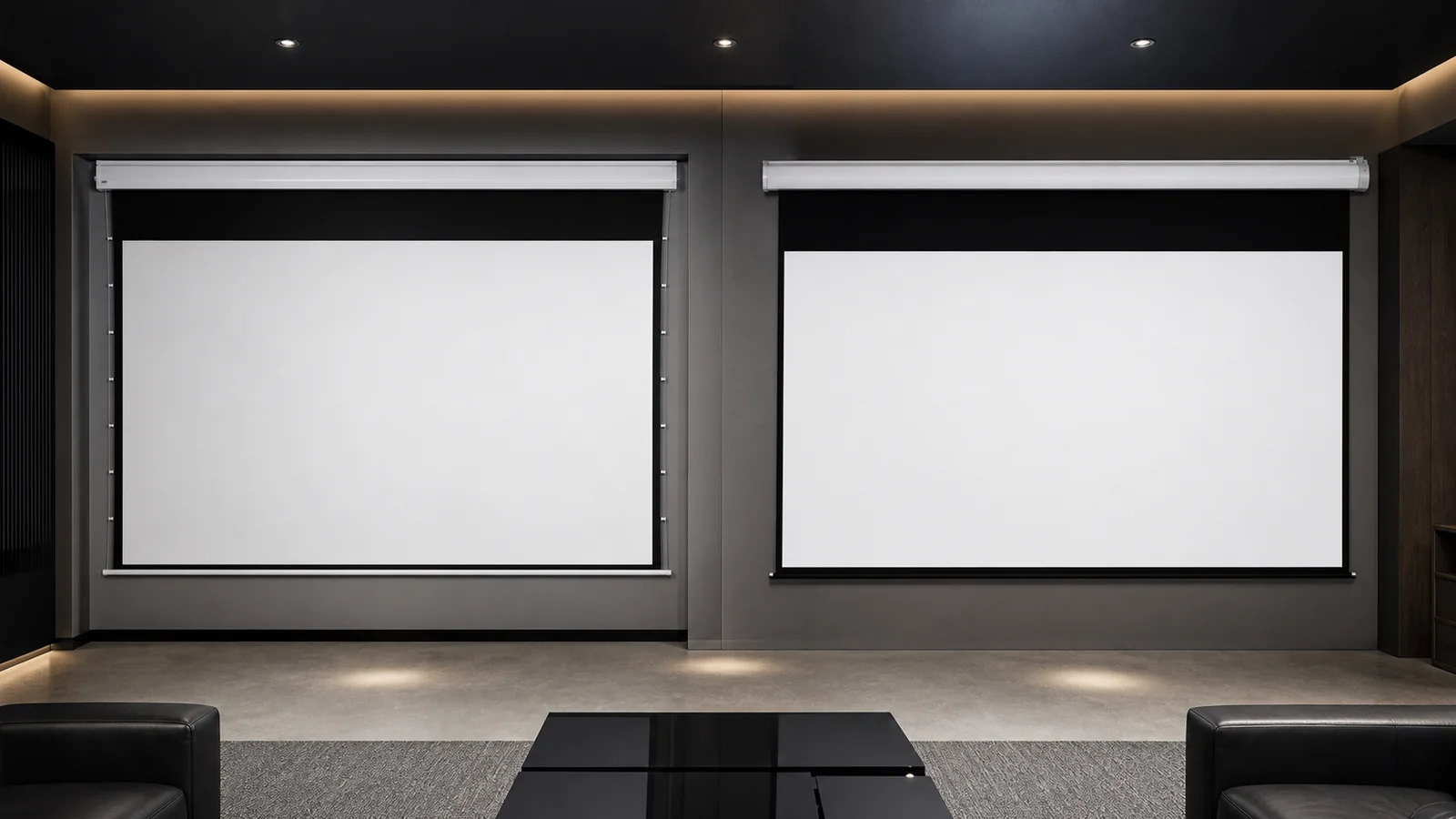
A tab-tensioned vs non-tensioned projection screen comparison should focus on surface structure, optical compatibility and acceptance—not only whether a screen is motorized. A tab-tensioned motorized projection screen uses side cables or cords and tensioning tabs to apply lateral force to the surface, while a non-tensioned motorized screen relies mainly on the roller and weighted bottom bar.
Choose tab tension when surface planarity is a high priority, the image is large or detailed, or the selected flexible material is designed for a tensioned system. Choose a standard non-tensioned motorized screen when the application is general presentation, budget and simplicity matter more, and the expected surface performance is acceptable for the room.
Tab tension reduces the risk of visible edge curl and waves, but it does not guarantee a perfectly flat surface under every condition. Material, manufacturing, screen size, installation alignment, storage, temperature and operation still matter.
In This Guide
At-a-Glance Comparison
Swipe to compare columns.
| Decision factor | Tab-tensioned motorized screen | Non-tensioned motorized screen |
|---|---|---|
| Side tension | Yes | No |
| Surface support | Top roller, bottom bar and lateral tension | Top roller and bottom bar |
| Typical flatness priority | Higher | General-purpose |
| Product complexity | Higher | Lower |
| Installation checks | Housing plus tension system clearance and alignment | Housing, bottom bar and deployment path |
| Material compatibility | Selected flexible tension-compatible materials | Materials suitable for standard roll-down use |
| Maintenance | Includes cables/tabs and tension balance | Fewer tension components |
| Typical cost | Higher | Lower |
| Best fit | Image-critical retractable installations | Meeting rooms, classrooms and general presentation |
Tensioned Formats Beyond Retractable Motorized Screens
This guide uses retractable motorized screens as its main comparison. The URL topic is broader, so use the following short boundary check before selecting a construction; it does not replace a product-specific drawing or quotation.
Swipe to compare columns.
| Format | How tension is created | When to compare it | Key limitation to confirm |
|---|---|---|---|
| Manual tab-tensioned screen | Manual operation with a tensioning structure designed for the selected product. | When power is unavailable but a retractable, controlled surface is still required. | Do not assume every manual pull-down screen accepts side cables or tension tabs. |
| Fixed-frame tensioned screen | Perimeter frame tension keeps the surface continuously stretched. | When the screen can remain visible and maximum surface stability has priority. | It is not retractable; check wall depth, trim and permanent viewing position. |
| Floor-rising tab-tension screen | Motorized lift plus a tensioned surface that rises from a floor enclosure. | When the wall must stay clear and the screen needs to retract into a floor-standing housing. | Confirm housing position, support, lift travel, power and service clearance; recessed installation requires separate model approval. |
| Portable fast-fold projection screen | Folding frame, surface attachment and support geometry rather than a roll-up side-cable system. | When events, trade shows or rental fleets need transportable large-format deployment. | Evaluate frame joints, surface attachment, case protection and setup workflow separately. |
For the operating, wiring and lifecycle comparison between motorized and manual screens, refer to the motorized vs manual projection screen guide. This page should remain focused on surface structure, optical compatibility and acceptance.
How Tab Tension Works
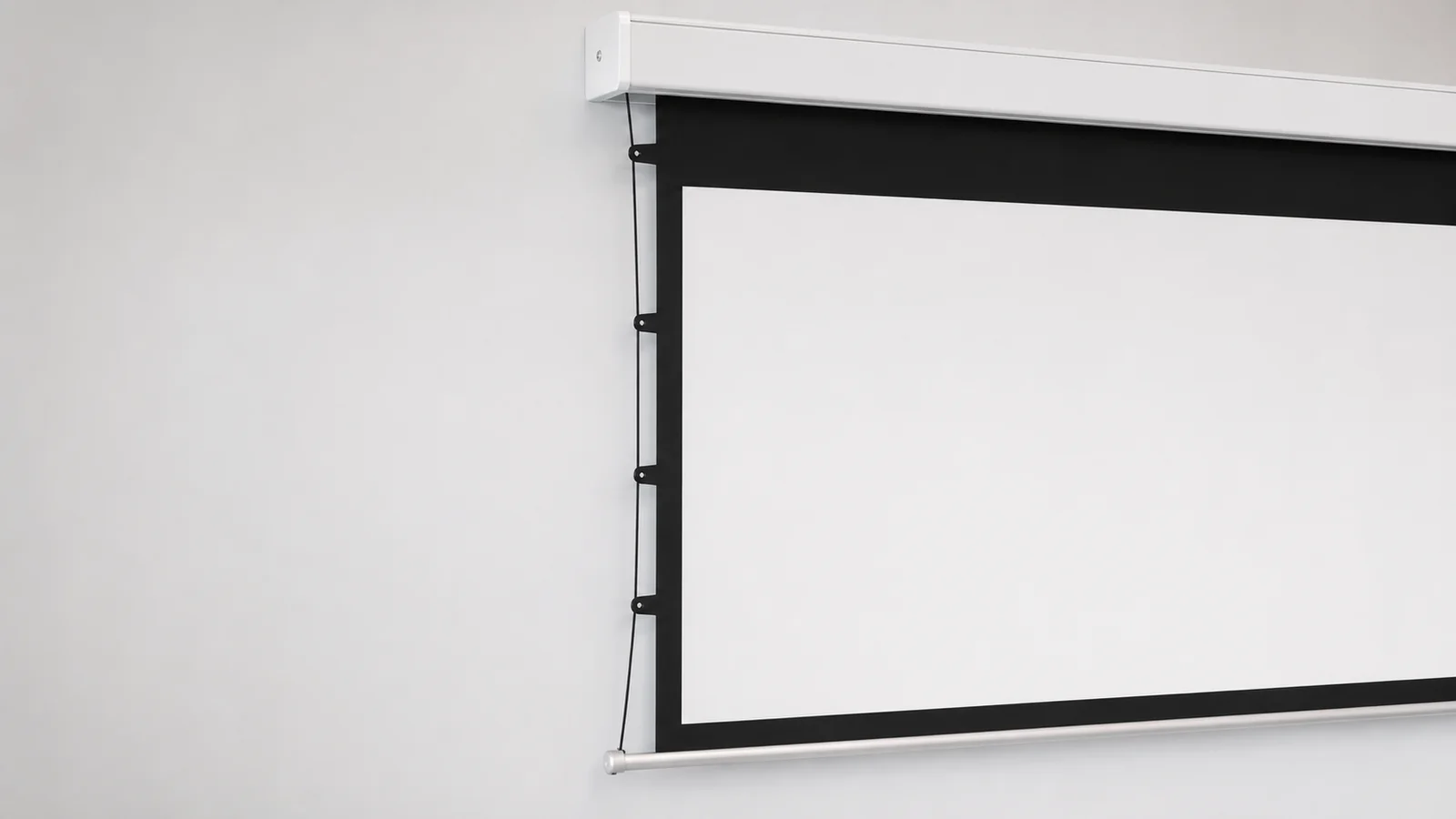
A retractable screen must roll into a housing, so its viewing surface is flexible. In a tab-tensioned design, tabs along both sides connect the material to tensioning cables or cords. The system applies controlled outward force while the bottom bar provides downward force.
The objective is to support the surface in more than one direction:
- the roller controls the top edge;
- the bottom bar applies vertical weight;
- the side system provides lateral tension;
- the material pattern and attachment distribute the force.
This is different from stretching a fixed-frame screen around a rigid perimeter. A tab-tensioned retractable screen remains a moving system and should be assessed as such.
Why Non-Tensioned Motorized Screens Can Develop Waves
Visible waves or edge curl can result from several interacting factors:
- natural behavior of flexible rollable material;
- unequal stress across the surface;
- larger viewing width or drop;
- repeated rolling and storage position;
- temperature and humidity changes;
- housing or roller misalignment;
- bottom-bar or mounting imbalance;
- unsuitable material for the mechanism;
- transport or handling damage.
A wave is not always caused by the motor. The motor moves the roller, but surface planarity depends on the full mechanical and material system.
When Tab Tension Is Worth Considering
Image detail makes distortion more visible
Fine text, grids, architectural lines and interface elements can make surface irregularities more noticeable. In an executive presentation room, visualization space or premium cinema, buyers may place greater value on a flatter retractable surface.
The screen is relatively large
As dimensions increase, flexible material must span a wider area. Size alone does not dictate the choice, but larger retractable images deserve closer review of material behavior and tensioning.
The selected material requires controlled flatness
Some PVC-based, grey, ambient-light-rejecting or acoustically transparent configurations may be offered in tensioned products. Compatibility must be confirmed for the exact material and projector; the label “ALR” is not enough to establish suitability.
The room needs a retractable screen but expects a premium image surface
A fixed-frame screen provides perimeter tension but remains permanently visible. When the architecture requires the screen to disappear, a tab-tension projection screen can bridge the gap between retractability and a stronger planarity requirement.
The installation is a dedicated cinema or design-led space
In a home theater application, a fixed-frame screen is often the first option when the wall can remain dedicated. Tab tension becomes relevant when the screen must retract to reveal a window, television, artwork or multipurpose wall.
When a Non-Tensioned Motorized Screen Is the Practical Choice
The room is used for general presentations
Standard motorized screens are widely suited to meeting rooms, classrooms and community spaces where presentation utility matters more than cinema-level surface expectations.
Simplicity and budget have priority
A non-tensioned design has fewer side-tension components and is generally more economical. Across many rooms, the difference can affect both procurement and maintenance planning.
The selected material and size perform adequately without side tension
Do not specify extra complexity without a project reason. If a sample or proven configuration provides acceptable performance at the required size, a standard motorized model may be the better value.
Fast, repeatable rollout is more important than premium specification
For standardized projects, reducing configuration variety can help installation, spare-parts control and user training. MGF’s electric projection screen range includes multiple housing and installation formats for comparison.
Six Factors to Compare Before Ordering
1. Projector Throw Type
Standard-throw, short-throw and ultra-short-throw projectors illuminate the surface at different angles. Geometry errors and surface irregularities can be especially apparent with very steep projection angles. Confirm the screen is designed and evaluated for the intended projector type.
Do not assume that adding side tension makes any material suitable for UST projection. Projector compatibility and surface optical behavior are separate requirements.
Material and Projector Compatibility Matrix
Material names are not enough to approve a screen. Standard-throw, short-throw and ultra-short-throw projectors illuminate the surface from different angles, and ALR or acoustically transparent surfaces can have directional or optical constraints. Tension improves mechanical support; it does not make a material UST-compatible.
Swipe to compare columns.
| Material direction | Projector type to evaluate | Tension support | Viewing angle / optical note | Ambient-light fit | Typical application |
|---|---|---|---|---|---|
| Matte white / soft white PVC | Standard throw; short throw only after model review | Often available in standard and tensioned directions, model-specific | Generally broad; confirm gain and hotspot behavior | Best in controlled or moderate light | Meeting rooms, classrooms, home theater and general presentation |
| Grey or ALR surface | Standard throw or specified short throw; never assume UST | Only the exact screen/material combination can confirm support | Often directional; record seating cone and projector position | Useful when selected ambient-light direction matches the optical design | Bright meeting rooms, living rooms and image-critical installations |
| Acoustically transparent woven surface | Standard or short throw according to the selected weave and projector | Model-specific; check rollability, attachment and size limits | Perforation or weave can affect resolution, moire and viewing distance | Usually requires controlled light for best contrast | Home theater and AV rooms with speakers behind the screen |
| UST-specific ALR / CLR surface | Ultra-short throw only with the specified projector geometry | Do not infer tension compatibility from the UST label | Usually has a defined vertical and horizontal viewing zone | Designed for a specific light direction and room condition | UST living rooms, classrooms or presentation spaces using the approved combination |
| Rear-projection material | Rear projection with projector placement behind the surface | Confirm whether the selected rear surface is offered in a tensioned or folding construction | Viewing direction, transmission and hotspot behavior must be tested from the audience side | Depends on the enclosure and light control behind the screen | Exhibitions, staging and temporary event installations |
Before approval, request the exact material name, gain or optical description where published, recommended projector geometry, viewing angle, tension compatibility, maximum supported size, roll or folding limits and a sample or test record.
2. Screen Material
The material must be compatible with both the optical application and mechanical system. Evaluate:
- projector throw and brightness;
- ambient-light direction;
- seating and viewing angle;
- image texture, hotspotting or sparkle;
- acoustic transparency if speakers sit behind the screen;
- rollability and tensioning requirements;
- intended image size.
MGF’s product information indicates that selected tab-tension models can be configured with options such as soft white PVC, selected ALR surfaces, woven acoustically transparent material or grey metallic material. Check the material names and compatible screen models, then confirm current availability and projector compatibility for the quoted configuration.
3. Housing and Installation Method
Both product types can use surface-mounted housings, while selected models support recessed ceiling installation. A tab-tension system also needs clear side-cable travel and balanced deployment.
For a concealed installation, review an in-ceiling tab-tension electric projection screen and verify housing dimensions, ceiling cutout, service access, power, controls, black drop and final image position before construction.
4. Screen Size and Aspect Ratio
MGF’s supplied product matrix lists common 4:3 and 16:9 configurations across several tab-tension models, with model-dependent size ranges. Standard electric families also include common 4:3, 16:9, 16:10 and selected 1:1 formats.
Use the visible image width and height—not only diagonal size—to evaluate projector throw, room fit and surface span. Custom sizing should be reviewed with a technical drawing.
Model-Specific Surface Acceptance Protocol
“Flat” is not a measurable purchase specification by itself. The buyer and supplier should agree on the following protocol before production, then attach the completed record to the purchase order or sample approval. The values below are a starting framework, not a universal tolerance for every material or size.
Swipe to compare columns.
| Acceptance item | What to record | Pass condition to agree in writing |
|---|---|---|
| Settling time | Fully deploy the screen and record the waiting period before inspection; a 30-minute starting point may be used if the model instruction does not specify another period. | Surface is assessed only after the agreed settling period and shows no new movement during the observation window. |
| Viewing distance | Record the minimum critical viewing distance in metres and the screen image height; do not approve from an unspecified close-up. | No objectionable wave, edge curl or geometry distortion is visible from the agreed audience position under the approved test pattern. |
| Test pattern | Use a fine grid, small text, horizontal and vertical lines, plus a black/white or grey field. | Pattern remains visually stable and readable against the signed sample or reference photographs. |
| Lighting and projector condition | Record room light, projector model, lens/throw, brightness setting, image mode and viewing direction. | Inspection is repeated under the same conditions used for sample approval; optical artifacts are logged separately from mechanical waves. |
| Left/right tension tracking | Record whether both side cables or tabs travel evenly, and photograph the left edge, centre and right edge. | No binding, asymmetric edge behavior, loose tab, obstruction or unapproved tension imbalance. |
| Dimensions and alignment | Record visible width, height, drop, housing level and bottom-bar alignment against the approved drawing. | Dimensions and alignment remain within the project drawing tolerance; deviations are listed and approved. |
| Evidence package | Save order number, model, material, date, serial or batch reference, test pattern and three or more inspection photos. | Report is traceable to the supplied configuration and signed by the responsible parties. |
For a repeatable report, name files with order, model, size, material, date and view position—for example, PO123_120in_ALR_left_2026-07-18.jpg. If a wave or edge curl is disputed, stop changing tension settings until the condition, installation level and photos are recorded.
5. Inspection and Acceptance Criteria
“Flat” is too vague for a purchase specification. For project or OEM orders, agree on how the deployed surface will be inspected:
- screen fully deployed for the specified settling time;
- viewed under defined lighting and image conditions;
- housing installed level and square;
- bottom bar and side cables correctly aligned;
- no transport damage or foreign material;
- image-area dimensions within the agreed tolerance;
- tension settings and stop positions confirmed.
If a particular line pattern or viewing distance will be used for acceptance, document it before production.
6. Service and User Handling
Users should not pull, push or attach items to a motorized bottom bar. Keep furniture and equipment outside the deployment path. For tab-tension systems, side cables and tabs should remain unobstructed and balanced.
Service access is important for the motor, controls and tension components. Ask which parts are adjustable or replaceable and obtain the current operating instructions for the exact model.
Configuration and Procurement Data to Confirm
The relative price levels below are directional only. MGF should quote the exact size, material, housing, control package and installation scope; no public category label should be treated as a fixed price or universal size limit.
Swipe to compare columns.
| Configuration direction | Typical price level | Installation / housing | Control direction | Maintenance items | Warranty / size note | MGF reference |
|---|---|---|---|---|---|---|
| In-ceiling tab-tension electric | Premium project level | Recessed ceiling housing; power, cutout, service access and side-cable clearance | Model-specific switch, remote, trigger or integration | Motor, controls, cable/tabs, brackets and access panel | Confirm exact warranty, size range and material compatibility by quotation | In-ceiling tab-tension screen |
| Surface-mounted tab-tension electric | Mid-to-premium project level | Wall or ceiling housing with balanced side travel | Model-specific control package | Motor, controls, cable/tabs and bottom bar | Confirm casing, drop, maximum size and service parts | Tab-tension range |
| Standard non-tensioned electric | Standard project level | Wall or ceiling housing; no side-cable clearance | Model-specific motor and control | Motor, roller, controls and bottom bar | Confirm material, size and expected surface behavior | Standard electric screen |
| Motorized floor-rising tab-tension | Premium project level | Floor-standing housing, support, lift travel and service access | Motorized lift and model-specific control | Lift drive, tension parts, guides and enclosure access | Confirm housing dimensions, lift travel, size and warranty | Floor-rising tab-tension screen |
| Fixed-frame tensioned | Standard-to-premium project level | Permanent wall frame; no roller or motor | No screen deployment control | Frame, surface attachment and wall hardware | Confirm permanent installation, frame size and material | Fixed-frame direction |
| Portable fast-fold | Project or rental-fleet level | Folding frame, legs, surface attachment and flight case | Manual setup; no screen motor | Frame joints, surface, fasteners and case | Confirm frame size, case, weight and setup crew | Portable folding direction |
Use this matrix to decide what must be quoted; use the product page and technical drawing to confirm what is actually available. A tab-tension system itself does not establish UST compatibility, a fixed-frame surface is not retractable, and a portable fast-fold frame is not equivalent to a roll-up side-cable design.
Approve the Complete Screen and Surface Combination
Specify the model, visible size, exact material name or code, projector model and throw position together. Confirm attachment, rollability, side-tension support and operating orientation for that combination. Neither an ALR label nor side cables alone establish UST compatibility.
Compare candidates with the same content, projector settings, lighting and viewing positions. Record the agreed inspection method and sample availability before ordering; do not substitute a generic flatness claim for the selected model’s acceptance record.
MGF Screen Configurations to Compare
In-ceiling tab-tension electric screen
The in-ceiling tab-tension screen combines concealed ceiling installation with a tensioned retractable surface. Confirm the exact material, controls, ceiling opening, side-cable travel and service access for the quoted model and size.
Premium aluminum-casing tab-tension screen
The premium aluminum-casing tab-tension screen is a surface-mounted option where recessed installation is unavailable. Review current mounting, size, material and control options during quotation.
Hexagonal tab-tension electric screen
The hexagonal tab-tension screen offers another surface-mounted housing format. Compare its dimensions, mounting method, material and control configuration; housing shape alone does not establish interchangeability.
Standard electric screen
A standard non-tensioned electric model can be appropriate for general business, education or multipurpose use. The standard electric projection screen provides a reference configuration for wall or ceiling mounting.
A Simple Selection Rule
Use a tab-tensioned screen when all three statements are true:
- the screen must retract;
- surface planarity is a material project requirement;
- the budget and maintenance plan can support the more complex system.
Use a standard non-tensioned motorized screen when:
- the application is general presentation;
- a proven standard configuration meets image expectations;
- simplicity, cost or multi-room standardization has higher priority.
If the screen does not need to retract, also compare a fixed-frame screen. The correct decision may be fixed frame rather than either motorized option.
Questions to Include in Your Inquiry
- What is the room and primary application?
- Which projector model and throw type will be used?
- What are the visible width, height and aspect ratio?
- Is the screen surface expected to retract after every use?
- Which material is being considered and why?
- Is wall, ceiling or recessed installation required?
- What power and control method is needed?
- Are there acceptance requirements for surface planarity?
- What quantity and destination market apply?
Related Planning Resources
FAQ
Does tab tension make a projection screen perfectly flat?
It helps control the surface and reduce visible waves or edge curl, but no retractable system should be described as unconditionally perfect. Material, size, installation, environment and adjustment still influence performance.
Is a tab-tensioned screen always better?
No. It is better when its surface benefit matters to the application. A standard motorized screen may be more economical and sufficiently effective for general presentations.
Can I add tension cables to a standard motorized screen later?
Do not assume so. Tab tension is an engineered system involving the material, tabs, cables, bottom bar and housing. Select the correct product design from the start.
Are tab-tensioned screens suitable for UST projectors?
Some specific screen-and-material combinations may be designed for UST use, but tension alone does not establish compatibility. Confirm the exact material, orientation, screen structure and projector model.
What causes one side of a tensioned screen to look different from the other?
Possible causes include installation alignment, unequal cable tension, obstruction, handling or a component issue. Stop operation if the screen is binding and follow the model-specific inspection or service guidance.
Request a Tab-Tension or Standard Electric Screen Recommendation
To compare configurations, send MGF your projector model, room type, visible image size, aspect ratio, material requirement, installation method, control needs, quantity and destination. The team can identify which current product types should be evaluated for the project.
Contact MGF Screens for a configuration review and quotation