OEM Projection Screen Packaging and Shipping Guide

Projection screens combine long profiles, finished housings, sensitive viewing surfaces and model-specific accessories. A package can look acceptable at the factory yet fail after repeated handling, stacking or a long export route. Packaging therefore belongs in the approved product specification—not as a decision made after production.
In This Guide
Map the Distribution Route
Describe how the carton moves from factory to end user: container loading, port handling, warehouse storage, parcel or LTL delivery, distributor transfer and final-site access. Record expected orientations, handling equipment, stacking conditions and any length restrictions.
Incoterms define commercial responsibilities but do not replace a packaging design or cargo-insurance decision. Confirm shipping terms, insurance, inspection and claim procedures with the responsible logistics parties.
Verify the route beyond the building entrance
Check doors, lifts, stairs, corridors and turning areas against confirmed packed dimensions and handling requirements. Record receiving staff, access bookings, the route to the room and temporary storage. Do not assume the product can be unpacked or separated simply to fit a restriction. Recheck the route when the final configuration or packaging changes, and resolve an unworkable route before dispatch.
Identify Product-Specific Risks
| Product | Primary packaging concerns |
|---|---|
| Fixed frame | Long profiles, corner finish, hardware completeness, surface folds |
| Motorized screen | Housing dents, end-cap impact, roller/surface movement, control accessories |
| Tab-tensioned screen | Side-tab and cable protection, bottom bar, surface pressure |
| Floor-rising screen | Base weight, mechanism restraint, upright handling, accessory compartment |
| Portable folding screen | Frame joints, snap surface, legs, case durability and case count |
Risk also changes with size. Do not assume the packaging for a small sample can be scaled directly to a long production model.
Build Protection From the Product Outward
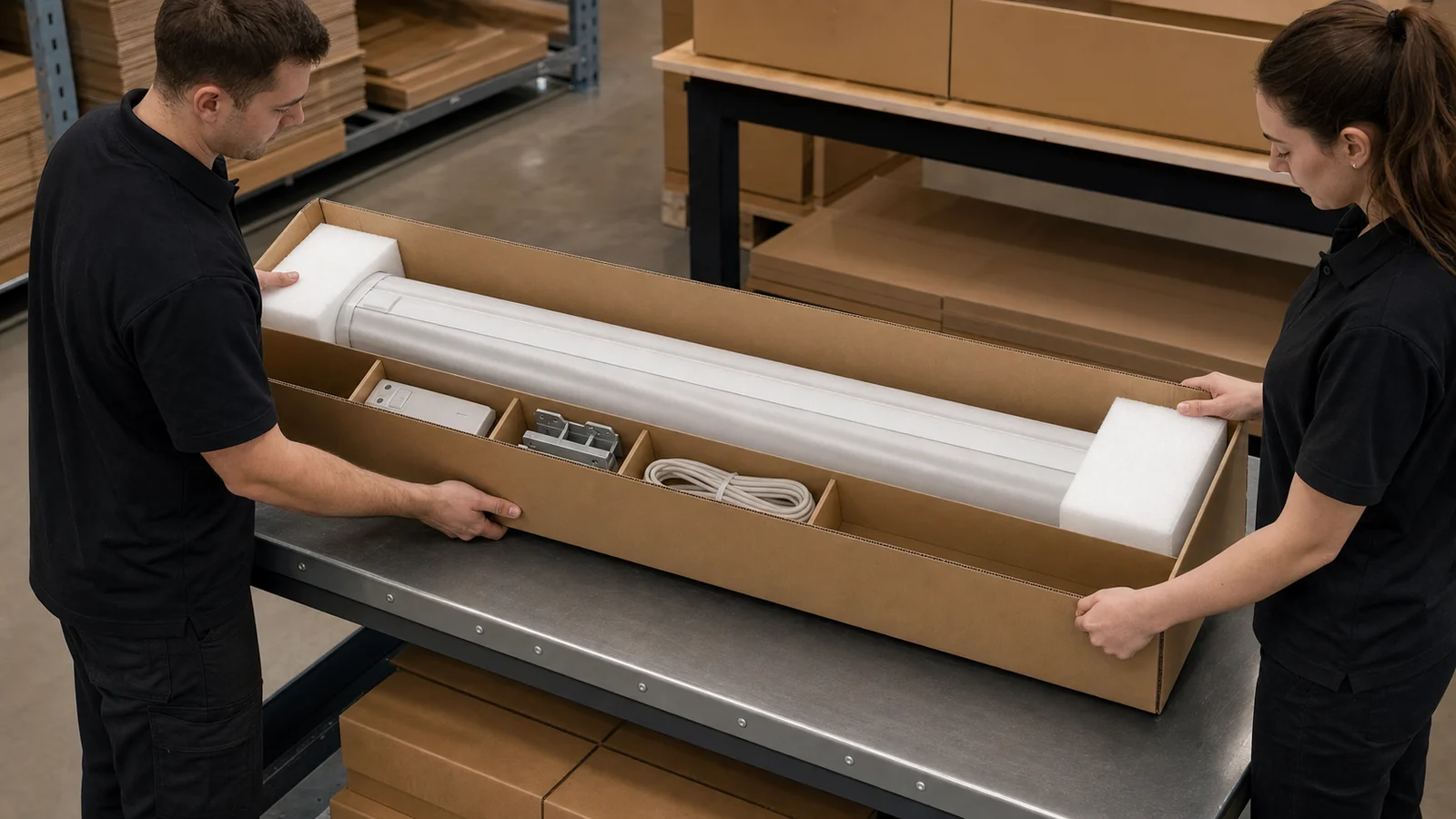
Protect the viewing surface from dirt, abrasion, sharp folds and loose hardware. Isolate remotes, brackets, fasteners and cables in identified compartments so they cannot strike the screen or casing. Protect finished ends and corners, then select an outer carton, pallet or crate solution appropriate to the approved route.
For motorized products, agree how the bottom bar and internal assembly are restrained for transport according to the product design. Do not improvise pressure points that could mark the surface.
Approve a Packaging Specification
The packaging file should define:
- product and carton dimensions and weights;
- internal protection materials and placement;
- accessory list and compartment layout;
- packing sequence and orientation;
- carton construction or crate/pallet arrangement;
- handling, storage and stacking instructions where validated;
- labels, model identity and barcodes;
- packing photos and inspection points;
- disposal or material restrictions for the destination.
Use drawings and photos to remove ambiguity. If the buyer requires retail artwork or private labeling, approve those elements during the OEM sample approval process.
Request a separate packing specification for each product structure
| Actual product reference | Packing specification to approve |
|---|---|
| SFF fixed frame | Frame sections, surface and hardware inventory; corner/face separation; complete carton dimensions and mass; proposed pallet/crate if required |
| Standard Electric long housing | End protection, approved restraint of moving components, accessory isolation and supported long-package handling; complete packed envelope/mass |
| Portable Folding Screen | Frame/legs/connectors/surface/case inventory; separated contact points; case IDs, dimensions/mass and transport method |
For every line, record packing drawing revision, ordered size/material, quantity per package and whether the quoted protection is standard supply or a project variation. Packaging, product mix and destination handling can change these values; no dimensions, mass or test rating are assigned without the issued packing list.
At receipt, the named receiving person records date/time and the unopened package’s four sides, labels and seals. During permitted unpacking, record the protection layers and component arrangement, then any damage and product/serial identity. Keep original photos linked to the package/order; follow the shipment’s agreed reporting procedure and deadlines.
Connect this evidence to model and document traceability and the production/shipping milestones. A damage record supports investigation; it does not establish responsibility or a guaranteed claim outcome.
Send model/size/quantity, distribution route, warehouse constraints and branding files. Request the actual packing list and any agreed validation evidence. Request a Model Packing Plan and Sample-Box Review.
Check the warehouse's receiving identifiers
Confirm how each package will be matched to an order line and sorted by configuration. Keep approved carton wording consistent with the product, size and buyer model reference. Link any receiving photographs to that package identity. Treat another product's carton photograph as an example, and retain the approved version for the actual shipment.
Checking a Long Screen Package Through Doors, Lifts and Corners
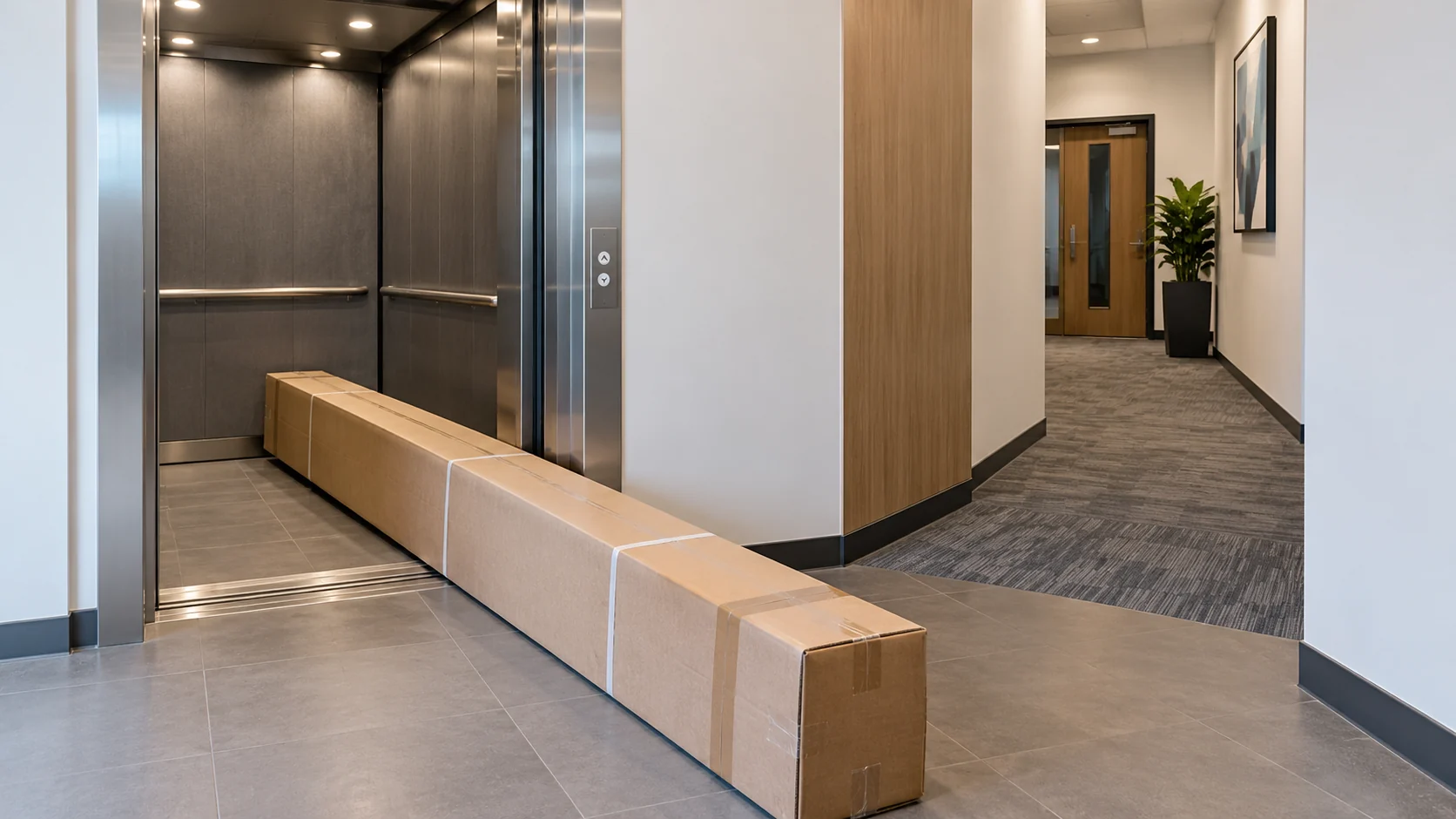
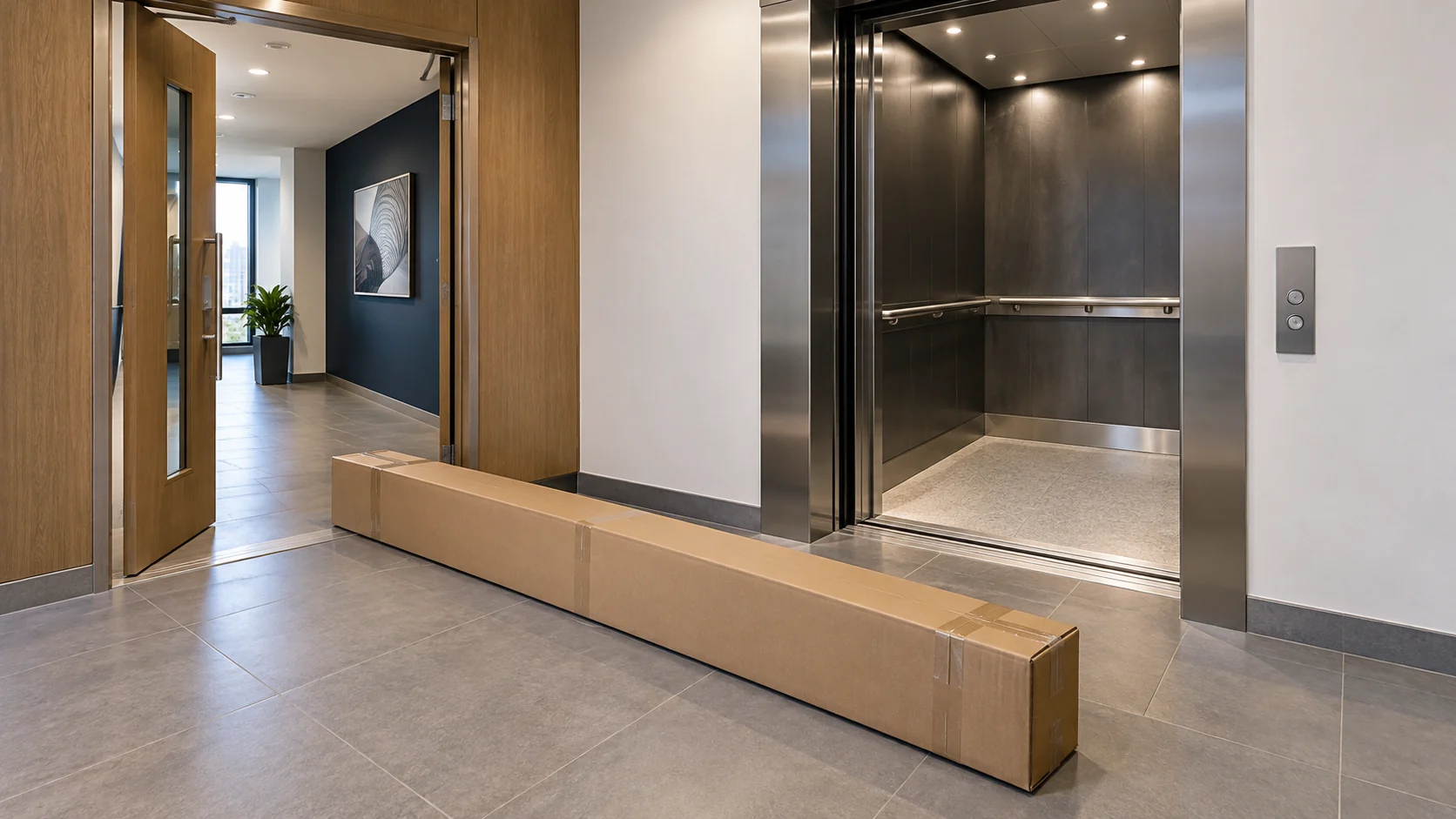
Check the delivery route against the package that will arrive, including its length, depth, handling restrictions and usable turning space. An entrance that accepts the carton does not establish that the lift or corridor turn will accept it.
Trace one package through the whole route
Assume a packed screen is 3.20 m × 0.25 m × 0.22 m. These are invented logistics dimensions, not an MGF package specification. A filled route review might look like this:
| Route stage | Assumed restriction | Review result / next decision |
|---|---|---|
| Building entrance | 0.90 m clear opening; straight approach | Narrow cross-section can enter, subject to the actual handling arrangement |
| Passenger lift | 2.00 m × 1.40 m floor; 2.20 m usable height | No straight horizontal fit; assess permitted orientation and doorway transition, or select another route |
| Lift landing | Restricted approach beside a fixed cabinet | A package that might fit inside the lift can still fail to enter or exit |
| Corridor corner | Two 1.20 m-wide corridors at a right-angle turn | Requires a turning-path review with package depth and handling space |
| Installation room | 3.50 m clear receiving area assumed | Connect staging to the accepted handling and storage plan |
For the assumed lift, the internal three-dimensional diagonal is about 3.29 m: √(2.00² + 1.40² + 2.20²). That is only a line-length comparison. A 3.20 m carton has depth, needs an entry motion and may have orientation restrictions. The arithmetic cannot approve the lift route.
Choose the route before dispatch
A failed passenger-lift transition may lead to a reviewed service lift or another approved access route. Unpacking at the entrance is an option only if the supplier's handling arrangement permits it and the team can protect and carry the assembly appropriately. Do not rely on an assumed ability to separate a motorized housing into shorter parts.
The Hexagonal Electric and Square Aluminum Casing Electric references identify the candidates whose final packaging information belongs in this decision. Similar picture sizes do not establish identical shipping envelopes.
Record who rechecks the narrow points at delivery time, books the accepted access and protects the staging area. Fit-outs can remove space that existed at the survey. Use the packaging and shipping guide to retain the route table with the final package and handling reference. That lets the receiving team follow an agreed route instead of improvising at the lift door.
Validate Before Shipment
Testing should reflect the product, package and distribution route. The exact test plan may include defined handling, vibration, drop, compression or environmental checks, but standards and acceptance criteria must be agreed rather than invented after damage occurs.
After validation, open the package and inspect the surface, housing, frame, mechanism, accessories and carton. Record the configuration and result. When product length, weight, material or route changes, decide whether revalidation is needed.
Control Loading and Shipment Evidence
Before loading, verify carton count, model, marks, visible damage and packaging orientation. Use a loading plan appropriate to long products and avoid unsupported overhang or concentrated pressure. Photograph critical stages without exposing confidential customer data.
Create a shipment evidence pack containing the packing list, carton/pallet count, inspection result, seal or container details where applicable, and loading photographs. This improves traceability if a shortage or damage claim occurs.
Define the Damage-Claim Process
Tell receivers to inspect the outer package before signing, photograph all sides and labels, and retain packaging when damage is suspected. Record the product serial/batch identity, affected components and unpacking condition.
The buyer, carrier, insurer and supplier should agree notification windows and evidence requirements in advance. A clear record helps distinguish packaging design, handling and concealed product issues.
Keep arrival observations separate from a damage diagnosis
Connect the package label and order line to overall photographs and relevant close-ups. Record when the issue was noticed, what was unpacked and who received it. Preserve original files and the packaging information requested for the review. Do not describe an assumed cause as an established shipping or manufacturing fault.
Follow the agreed supplier and carrier reporting procedure, including applicable deadlines for the actual shipment. Request model-specific advice before operation, disassembly or attempted repair where damage may affect use. This record supports review; it does not promise claim acceptance or compensation.
FAQ
Should projection screens be shipped on pallets?
It depends on product length, weight, carton construction, route and handling method. The logistics plan should determine whether pallet, crate or another solution is appropriate.
Is the retail carton enough for export shipping?
Not automatically. Validate the complete package against the intended distribution environment and any additional handling stages.
How should screen fabric be protected?
Keep it clean, isolated from loose hardware and protected from abrasion, pressure and unintended folds according to the product’s approved packing method.
What packaging should be checked on an OEM sample?
Review internal protection, accessory placement, carton fit, labels, opening sequence and the condition of the product after unpacking.
What evidence is needed for a shipping damage claim?
Typically, retain photos of the unopened package, labels, damage, internal packing and product identity, plus transport and receipt records required by the responsible parties.
Packaging requirements can be reviewed through MGF's private-label packaging and production coordination process for the selected configuration.
Plan Packaging With the Product
Send MGF Screens your screen type, size range, order quantity, destination, distribution route, branding and packing requirements. We can align packaging approval points with the OEM ordering process and quality plan.
---