OEM Projection Screen Ordering Process: 8 Steps from Sample to Shipment

A reliable OEM projection screen ordering process should move through defined approval gates: requirement brief, product matching, commercial quotation, sample or pre-production approval, technical drawing, packaging and label approval, production quality control, pre-shipment inspection and document release. Buyers evaluating an OEM projection screen manufacturer or OEM projection screen supplier should also clarify private-label projection screen scope, projection screen OEM MOQ, sample approval and lead-time assumptions for the exact model.
The clearer the buyer’s inputs are at the beginning, the fewer changes occur after production starts.
In This Guide
Who This Process Is For
This guide is intended for:
- projection and AV distributors;
- private-label screen brands;
- system integrators standardizing project products;
- importers and wholesalers;
- contractors purchasing for multi-site projects;
- buyers who need custom packaging, labels, controls or materials.
MGF’s partner program provides the commercial starting point for distributors and project partners.
OEM vs ODM vs Private Label
Clarify the commercial model before the quotation is approved:
| Model | Buyer controls | Supplier scope to confirm |
|---|---|---|
| OEM | Product direction, specifications, brand files and acceptance criteria. | Manufacturing to the approved configuration and controlled documents. |
| ODM | Performance brief, target market and required adaptations. | Existing product platform plus agreed engineering or configuration changes. |
| Private label | Brand identity, packaging, labels, manuals and channel requirements. | Supply under the buyer’s brand with the exact product and documentation scope confirmed. |
Standard Product vs Custom Product
A standard product can shorten approval when the size, material, housing and controls already match the project. A custom product may involve a different material, casing, motor, bracket, label, carton, manual or electrical requirement. Treat every change as a configuration item with its own drawing, sample, MOQ, lead-time and inspection impact.
The Eight-Stage Ordering Process
| Stage | Buyer provides | Supplier confirms | Approval gate |
|---|---|---|---|
| 1. Requirement brief | Product, size, quantity, market and application | Feasible product directions | Requirement summary |
| 2. Configuration | Material, housing, control and accessories | Model and option matrix | Configuration sheet |
| 3. Quotation | Delivery term and documentation needs | Price, MOQ, sample and lead-time conditions | Commercial approval |
| 4. Sample / pre-production | Sample purpose and acceptance criteria | Sample build and test scope | Signed sample record |
| 5. Artwork / drawing | Logo, label, carton and manual files | Technical drawing and artwork proof | Written approval |
| 6. Production / QC | Final purchase order | Production plan and inspection records | Internal release |
| 7. Pre-shipment | Inspection method and documents | Quantity, packaging and product status | Shipment approval |
| 8. Logistics / feedback | Forwarder and destination details | Export documents and handover | Receipt and improvement log |
Stage 1: Build a Complete Requirement Brief
Send a structured request instead of only asking for “100-inch motorized screens.” Include:
- target product type;
- visible image size and aspect ratio;
- installation method;
- screen material or performance requirement;
- projector throw type;
- control method;
- accessories;
- quantity by model and size;
- target market and electrical requirement;
- branding and packaging scope;
- required documents;
- desired delivery window and destination.
For project orders, add room drawings, ceiling conditions and photos. For distribution orders, add the intended assortment and expected sales channel.
Stage 2: Match the Product Configuration
The supplier should convert the request into a configuration that can be quoted and inspected. A useful configuration sheet identifies:
- product family and model;
- housing or frame structure;
- image and overall dimensions;
- material name;
- motor and control direction;
- brackets, cables and accessories;
- logo and color requirements;
- packing method;
- documentation language.
MGF’s product range includes electric, tab-tension, fixed-frame, manual, portable and floor-rising formats. Buyers can compare the projection screen product categories before requesting a configuration.
Avoid approving a product only from a marketing name. Match the technical drawing and option list to the purchase order.
Stage 3: Confirm Commercial Terms
MOQ, sample cost and lead time often vary by:
- model and size;
- standard versus custom material;
- housing color or structure changes;
- motor and control package;
- logo method;
- custom carton, insert or manual;
- mixed-model order complexity;
- compliance and document requirements;
- production capacity at the order date.
Ask the quotation to state:
- unit configuration and price basis;
- MOQ by model, size or artwork;
- sample price and freight responsibility;
- tooling or setup charges where applicable;
- estimated sample and production timing;
- payment milestones;
- delivery term and destination assumptions;
- quotation validity;
- inclusions, exclusions and optional items.
Do not assume that a sample MOQ, pilot order MOQ and repeat-order MOQ are identical.
Stage 4: Define the Sample Purpose
A sample can answer different questions. State whether it is for:
- product quality evaluation;
- projector and material testing;
- customer demonstration;
- packaging drop or handling review;
- electrical and control validation;
- photography and sales preparation;
- final pre-production approval.
Create an acceptance checklist before the sample arrives. Review dimensions, housing finish, screen deployment, surface condition, control response, accessories, labels, carton and documentation.
If changes are requested, record them in one revision list. Mark whether the approved sample becomes the production reference and how deviations will be handled.
Sample Approval Checklist
| Sample checkpoint | Buyer approval question |
|---|---|
| Configuration | Does the model, size, aspect ratio, material, housing and control match the approved brief? |
| Performance | Does deployment, stop position, surface appearance, viewing direction and control response meet the acceptance criteria? |
| Branding | Are logo position, rating label, SKU, barcode, carton and manual revision correct? |
| Packaging | Are the surface, housing, accessories and corners protected for the planned distribution route? |
| Approval record | Is the sample reference number, revision date, open issue list and production-deviation rule recorded? |
Typical OEM Documents
Ask the supplier to identify which documents are available for the selected configuration and destination market:
- configuration sheet and technical drawing;
- bill of materials or option list where supplied;
- sample approval record and revision log;
- inspection plan and pre-shipment report;
- packing list, carton marks and barcode mapping;
- installation guide, user manual and material information;
- applicable certification or test documents;
- warranty scope, spare-parts route and after-sales contact.
Stage 5: Approve Technical and Branding Files
Production should not rely on instructions scattered across chat messages. Maintain a controlled approval package containing:
- final product drawing;
- bill of materials or option sheet where supplied;
- logo artwork in the required format;
- product label and rating-label proof;
- carton artwork and shipping marks;
- barcode and SKU mapping;
- manual and insert files;
- accessory list;
- packaging layout;
- approved sample or reference photographs;
- revision number and approval date.
Check trademark ownership and destination-market labeling requirements before printing.
How to Evaluate an OEM Projection Screen Supplier
A process description is only one part of supplier qualification. Ask for evidence that can be tied to the actual product and order rather than relying on generic claims.
| Evidence to request | What it should prove | MGF reference or next step |
|---|---|---|
| Factory and production walkthrough | Where assembly, inspection, packing and product handling take place. | Factory & Production; request current photos or a video for the relevant line. |
| Certificates and test documents | Which documents apply to the exact supplied component, market and configuration. | Certificates; confirm document number, scope and validity. |
| OEM/private-label capability | Whether branding, packaging, manuals, labels and configuration control are supported. | Partner Program; list the requested branding package in the RFQ. |
| QC and packaging records | How dimensions, operation, surface, accessories, labels and packing are checked. | Request an order-specific inspection plan, sample report or packing reference. |
| Warranty and after-sales process | How defects, spare parts, replacement components and claims are handled. | Require the written warranty scope, response route and spare-parts assumptions in the quotation. |
| Real OEM reference | Whether a comparable product or market application has been supplied. | Request a shareable case, redacted record or reference subject to confidentiality. |
Stage 6: Agree on Quality Control
The inspection plan should define what is checked, when it is checked and how results are recorded.
Relevant projection-screen checkpoints may include:
- incoming housing, frame, surface and control components;
- size and aspect-ratio verification;
- casing, frame and bottom-bar appearance;
- surface cleanliness and visible defects;
- screen movement and stop positions;
- remote or configured control response;
- tensioning and alignment where applicable;
- accessory count;
- label and artwork version;
- carton, protection and shipping marks;
- final quantity and packing list reconciliation.
For motorized products, agree whether production or final inspection includes operating-cycle checks and how the sampling method is defined. Do not publish a numeric test claim unless the current order or quality record supports it.
Stage 7: Approve Packaging for the Real Supply Chain
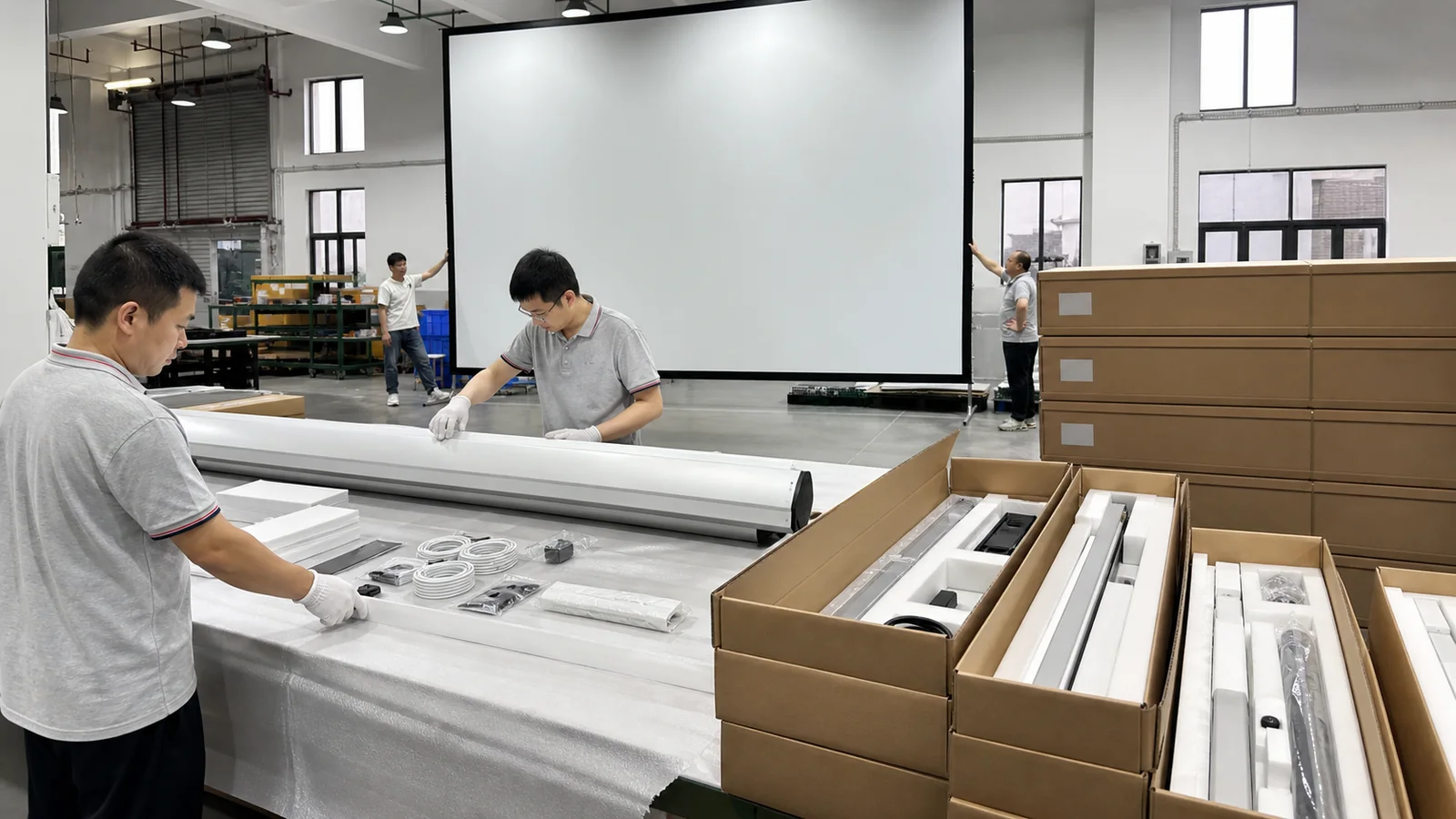
Projection screens are long products with surfaces and housings that can be damaged by impact, compression, moisture or poor handling. Packaging review should consider:
- product length and gross weight;
- housing and end-cap protection;
- bottom-bar restraint;
- frame-corner protection;
- surface isolation from sharp accessories;
- accessory compartment and count;
- inner supports and carton strength;
- pallet or container loading plan;
- handling marks and barcode visibility;
- distributor warehouse and last-mile conditions.
Ask for packaging photographs or a packing reference for the approved configuration. Confirm whether custom printed cartons require a separate MOQ or setup condition.
Stage 8: Complete Pre-Shipment Approval
Before release, reconcile:
- purchase order quantities;
- model, size and material;
- logo and label versions;
- accessory quantities;
- carton marks and barcodes;
- inspection result;
- packing list;
- commercial invoice details;
- current compliance documents requested for the order;
- forwarder and pickup instructions.
The buyer should state whether inspection is by factory record, buyer representative or an agreed third party. Define the inspection scope before production, not after the goods are packed.
How to Manage Lead Time
Lead time should be divided into stages:
```text Requirement confirmation → Sample or drawing approval → Material and component preparation → Production → Quality inspection → Packaging → Shipment booking and pickup ```
Ask what event starts the production clock: deposit receipt, purchase-order confirmation, artwork approval, sample approval or material arrival. Track changes separately because late revisions can reset part of the schedule.
Build logistics time and destination clearance into the buyer’s project plan. Factory completion is not the same as delivery to the final warehouse or site.
Change-Control Rules
Use one written change log with:
- request date;
- requested change;
- affected model and quantity;
- drawing, artwork or packaging revision;
- price impact;
- timing impact;
- person approving the change.
After production begins, even a small label, material or control change may affect completed work. Require written confirmation before implementation.
Common OEM Ordering Mistakes
- Requesting a price without a complete configuration;
- treating website photos as technical approval drawings;
- assuming one MOQ applies to all sizes and customization;
- ordering a sample without acceptance criteria;
- approving artwork but not the physical label position;
- changing files through multiple messaging channels;
- leaving packaging review until production is finished;
- asking for test reports without naming the destination requirement;
- confusing factory completion with final delivery;
- failing to record improvements after the first shipment.
FAQ
What is the MOQ for OEM projection screens?
MOQ depends on product type, size mix, material, branding, packaging and production conditions. Send the complete assortment and customization scope for a current quotation.
Should I order a sample before bulk production?
It is advisable when the product, material, control, branding or packaging has not been approved previously. Define what the sample must prove and whether it becomes the production reference.
Can different screen sizes be mixed in one OEM order?
This may be possible, but MOQ and pricing can apply by model, size, artwork or packaging version. Confirm the mix in the quotation.
What packaging can be customized?
Possible directions may include labels, cartons, inserts, manuals, barcodes and shipping marks. Availability and MOQ depend on the product and artwork scope.
How should buyers verify production quality?
Use an agreed inspection plan covering configuration, dimensions, operation, surface, accessories, branding and packaging. Decide the sampling and approval method before production.
When the requirement brief is ready, start an OEM projection screen project with the product, quantity and destination details.
Start an OEM Projection Screen Order
Send MGF your target products, sizes, materials, controls, quantity, target market, branding files, packaging needs, required documents and delivery destination. Ask for a configuration summary and current commercial conditions before approving the purchase order.