Projection Screen Sample Approval Checklist for Importers
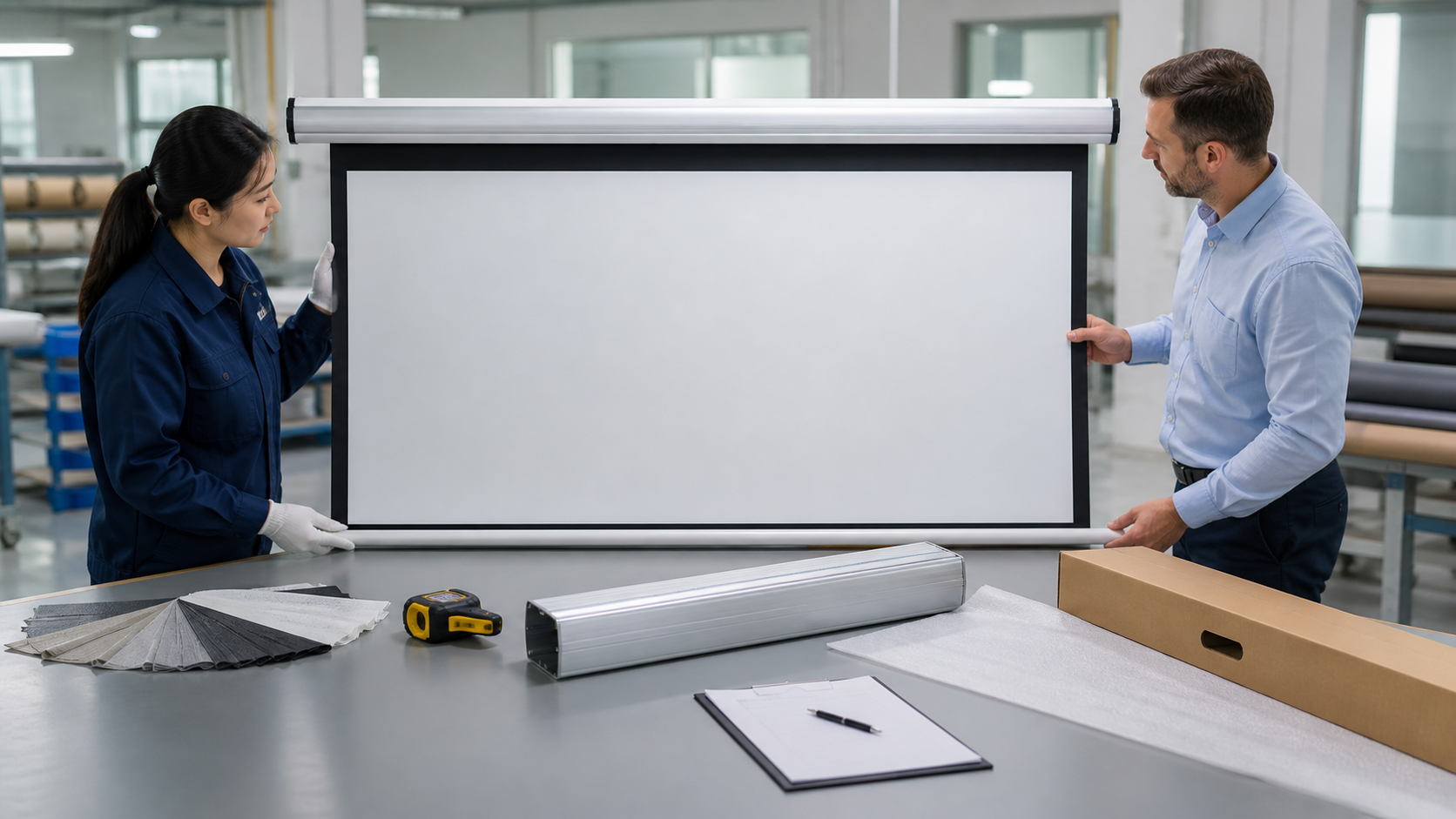
A controlled sample-approval workflow for importers reviewing projection screen specifications, operation, branding, packaging and production references.
In This Guide
Quick Answer
An OEM projection screen sample should be approved against a written specification and revision, not judged only by appearance. The buyer should confirm product identity, visible image dimensions, structure, surface, operation, controls, accessories, branding, documentation and packaging. Every deviation needs evidence, an owner and a recorded decision before production is released.
The approved result becomes the reference for the purchase order, production inspection and future repeat orders. A controlled golden sample can support that reference, but only when its model, revision, storage responsibility and relationship to the approved drawing are documented. This is how an importer reduces sample-to-production drift instead of relying on messages or memory.
Choose the Right Sample Stage
Not every sample answers the same question. Define the approval purpose before requesting a unit.
| Sample stage | Main purpose | Appropriate decision |
|---|---|---|
| Material swatch | Compare surface direction, texture and finish | Shortlist a material for a specified projector and room condition |
| Standard product sample | Review the supplier's baseline structure and operation | Decide whether the product family deserves a configured sample |
| Customized sample | Verify dimensions, controls, branding, accessories and packaging | Approve or revise the intended private-label configuration |
| First production article | Confirm that production setup matches the approved reference | Release the documented configuration for the agreed production stage |
A material swatch cannot approve a complete motorized or fixed-frame product. Conversely, a full unit can still fail as a useful approval sample if the buyer has not identified which details are standard, customized or still under evaluation.
Freeze the Review Package Before Sampling
Create one controlled review package before the factory prepares the sample. It should identify the product family, model or working code, visible image width and height, aspect ratio, overall dimensions, surface direction, housing or frame, mounting method, motor and voltage where relevant, control method, accessories, finish, labels, manual and packaging direction.
Assign a revision to the package and name the buyer and supplier contacts responsible for technical decisions. The OEM projection screen RFQ guide can help structure the initial requirement set, while the OEM & Procurement guide library provides related sourcing checks.
Avoid descriptions such as “a standard 120-inch electric screen” without the visible dimensions, ratio, border/drop direction, housing and material. A diagonal label alone does not freeze the delivered configuration.
Importer Approval Checklist
| Check area | What to inspect | Approval evidence |
|---|---|---|
| Identity | Model or working code, revision, supplier and sample date | Sample record and label photographs |
| Image area | Visible width, height, aspect ratio, border and drop | Measurement sheet linked to the drawing |
| Surface | Material identity, direction, marks, texture and installed behavior | Labeled notes and representative images |
| Structure | Housing/frame, end caps, brackets, joints and fasteners | Drawing comparison and detail photographs |
| Operation | Deployment, retraction, stop positions and tracking where applicable | Test log or video |
| Controls | Ordered remote, wall control or integration interface | Model-specific control test record |
| Branding | Logo, labels, manual, carton marks and revision | Approved artwork and sample photographs |
| Accessories | Included parts, quantity and compatibility | Packing checklist |
| Packaging | Carton, internal protection, accessory separation and labels | Unboxing record and corrective-action list |
Inspect the Package Before Opening
Photograph the outer carton, corners, straps, shipping marks and any visible damage before opening. Record whether the package arrived wet, crushed, punctured or re-taped. This evidence helps distinguish factory packing concerns from transport or local handling damage.
Open the package in a controlled sequence. Record internal supports, surface protection, accessory bags, manuals and labels. For private-label work, compare every visible brand element with the approved artwork revision. The private-label projection screen guide explains why product identity and packaging approval need to remain connected.
Measure the Screen and Structure
Measure visible image width and height separately from overall dimensions. Check aspect ratio, black border, extra drop, housing or frame size, bracket spacing and required service clearance against the approved drawing. Record the method used and the agreed project tolerance rather than inventing an acceptance threshold after seeing the result.
For a fixed-frame projection screen, review squareness, corner joints, tensioning points and wall-mount hardware. For a tab-tension projection screen, review the casing, bottom bar, side-tension components and the installed image plane without treating the scene image as proof of a specific model.
Test Operation and Controls
For retractable products, use the ordered control to run representative deployment and retraction checks. Observe stop positions, tracking, unusual sound, remote response and cable entry. If integration is required, test only the interfaces confirmed for the exact controller and market; RF, IR, trigger, dry contact and RS-485 should not be treated as interchangeable labels.
Use the motorized screen commissioning guide to document functional observations. Do not open a housing, adjust limits or perform an informal repair unless the model instructions and responsible technical party authorize the procedure.
Review the Surface in the Intended Geometry
Deploy or assemble the screen in the intended orientation and inspect it with the planned projector and room conditions where practical. Review marks, texture, color neutrality, hotspotting, visible waves, edge behavior and image consistency from relevant viewing positions. Interpret flatness according to the product type and installation condition rather than expecting different constructions to behave identically.
For acoustic or directional surfaces, record installation direction and the relevant projector, speaker and seating arrangement. A small desk sample may support material selection, but it does not verify the complete structure, tension system, operation or packing protection.
Confirm Branding, Documentation and Accessories
Compare the housing or frame mark, model label, rating information, manual language, remote or controller label, accessory bag and carton artwork against the approved brand specification. Identify who owns the final artwork and which file revision production will use.
Confirm that supplied brackets, fasteners, cables, controls and instructions correspond to the tested configuration. A visually correct sample with the wrong accessory or document revision is not a complete approval reference.
Record Deviations, Decisions and Sign-Off
Use a numbered deviation list with the requirement, observed condition, evidence, corrective action, owner and due decision. Classify each item as approved, approved with documented changes, rejected, or requiring a changed component or re-sample. Verbal approval should be converted into the controlled record.
If a deviation is accepted, revise the drawing, specification or approval record so the final reference and production instruction agree. If the sample itself is changed, photograph and relabel the final state. The buyer's product or technical owner and the supplier's authorized contact should be named in the sign-off record.
Connect the approved reference to the projection screen quality control checklist. Production inspection should use the same fields, terms and revision identity that the sample approval used.
Prevent Sample-to-Production Drift
- Do not substitute a material using only a generic marketing name.
- Lock the approved motor, controller, accessories and connector direction where applicable.
- Release final artwork before printing labels, manuals or cartons.
- Separate one-time sample construction from the repeatable production method.
- Approve packaging after the final product configuration is known.
- Record any proposed production difference before order release.
- Define who retains the golden sample and how later inspections refer to it.
The Factory & Production page gives buyers context for discussing process evidence, but the acceptance record still needs to be specific to the selected product and order.
Apply the Checklist to an MGF Screen Configuration
Start with a recorded material code and compatible screen model. For MGF in-ceiling electric screens, 12 V trigger, RS-485, manual wall switch and dry-contact control are supported; confirm the exact controller, included accessories and wiring before defining the sample test. The motor noise reported by MGF is approximately 30 dB; the sample record should state the motor and measurement conditions instead of applying this as a whole-screen acceptance limit.
For a conference-room project, include the room, projector and installation requirements with the sample brief.
Share the model, material code, controls and approval evidence required for your order.
Review OEM and sample requirementsFAQ
Is a material swatch enough for projection screen sample approval?
It can approve a material direction for further evaluation, but it cannot verify the complete structure, operation, controls, branding, accessories or packaging. A representative configured unit or first article may be needed when those items affect the order.
What is a golden sample?
It is a controlled physical reference representing the accepted configuration. Its identity, revision, storage responsibility and use in production inspection should be documented; the label alone does not make it authoritative.
Can photographs replace a physical sample?
Photographs can document identity, finish, labels and visible changes, but they cannot fully verify surface behavior, dimensions, operation, controls or packaging protection. The appropriate evidence depends on product risk and customization scope.
Can production begin before every sample item is closed?
Overlapping activities can increase risk. If the commercial schedule requires partial release, identify exactly which work is authorized, which decisions remain open and who accepts the exposure. Silence should not be treated as approval.
When is a second sample appropriate?
A second sample is useful when the first unit requires a material, dimension, control, branding or packaging change that cannot be verified reliably through a controlled component or documented evidence. The parties should agree on the re-approval method.
Who should sign the approval record?
The buyer's technical or product owner and the supplier's authorized contact should be identified. Names, authority and any additional inspection party are project-specific and should be confirmed by the parties.
Send a Sample Approval Request
Share the target product family, visible dimensions, aspect ratio, surface direction, control needs, branding scope, packaging requirements, destination market and required evidence through Contact MGF Screens. MGF can then confirm which information is needed for a configuration-specific sample and quotation discussion.