Acoustic Transparent Projection Screen Guide for Home Theaters
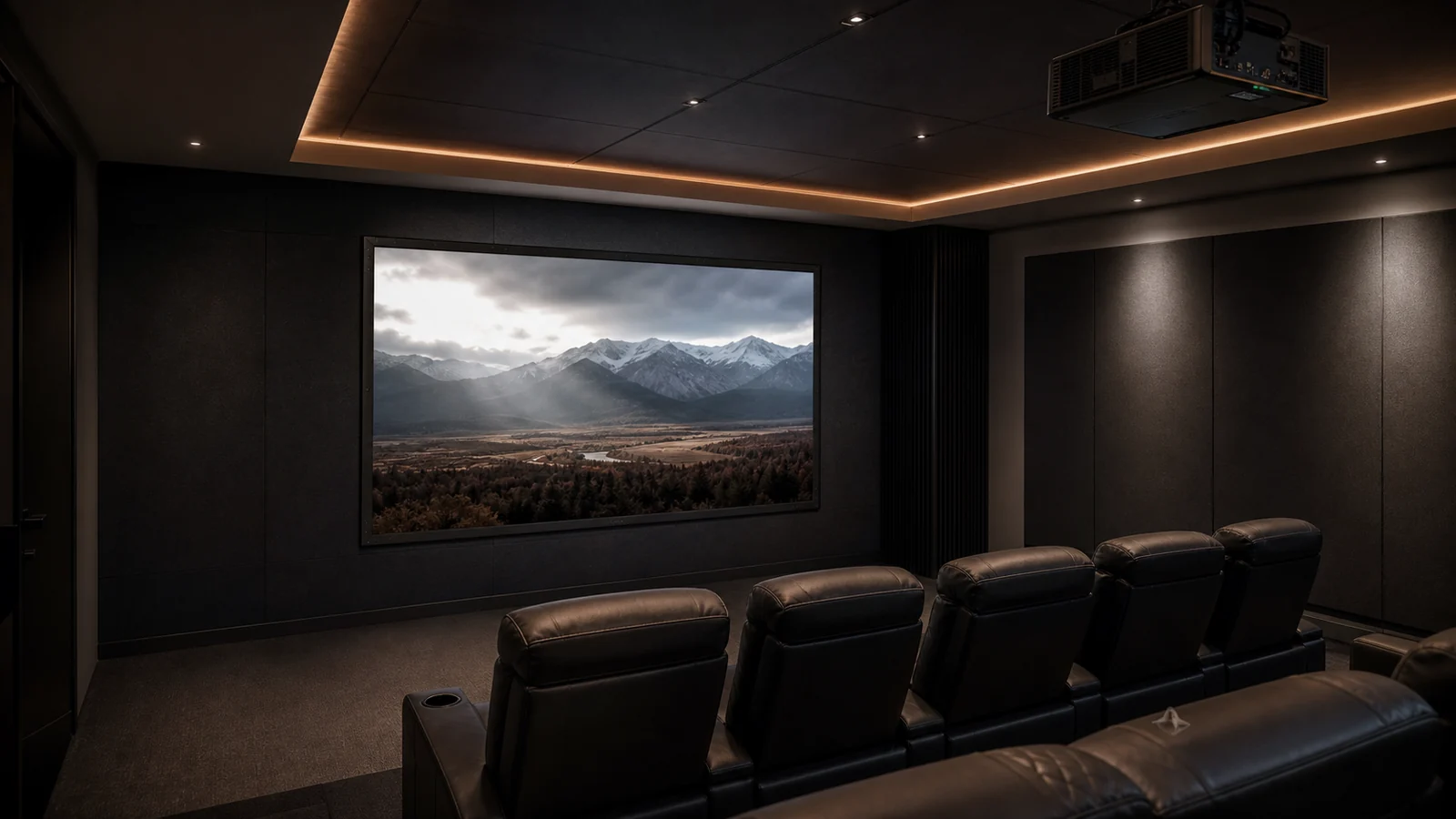
An acoustically transparent projection screen allows the front speakers to sit behind the image, so dialogue appears to come from the actors rather than from a speaker above or below the screen. This is one of the most useful layout tools in a dedicated cinema—but the material introduces optical and acoustic trade-offs that should be tested, not hidden behind a single specification.
This guide explains when an acoustic screen is appropriate, how common surface structures differ and what integrators should verify before ordering.
In This Guide
When an Acoustic Screen Solves the Room
An acoustic transparent screen is most valuable when:
- the center speaker would otherwise sit too high or too low;
- a larger image would conflict with visible speakers;
- the design calls for a clean front wall;
- identical left, center and right speakers should align behind the image;
- a baffle wall or dedicated speaker cavity is planned.
If speakers can already be positioned correctly around a smaller screen, a conventional surface may be simpler and may preserve more light. The right question is not “Is acoustic transparent premium?” but “Does hiding the speakers solve a real layout or imaging problem?”
Woven and Perforated Surfaces
| Surface structure | General behavior | Main items to test | Common structural fit |
|---|---|---|---|
| Woven | Sound passes through gaps in interlaced fibers | Visible texture, weave pattern, moiré, color uniformity | Fixed frame; selected tensioned systems when approved |
| Micro-perforated | Sound passes through small holes in a film-like surface | Hole visibility, moiré, high-frequency effect, seating distance | Commonly fixed tension; compatibility depends on material |
Neither category guarantees better sound or image quality by name alone. Hole or weave geometry, backing, projector pixel structure, seating distance and speaker placement all interact. Request the exact material sample, not a generic “acoustic fabric” label.
MGF product information lists white woven acoustically transparent, PVC acoustically transparent and acoustically transparent metallic material options across selected fixed-frame and tensioned products. Availability and suitability must be confirmed for the chosen structure and size.
The Five Trade-Offs to Evaluate
1. Sound Transmission
Any material placed between a speaker and listener affects sound to some degree. The important question is whether the change is predictable and can be managed by speaker setup and room calibration. Ask for material-specific acoustic information where available, then test a production-representative sample if the project standard requires it.
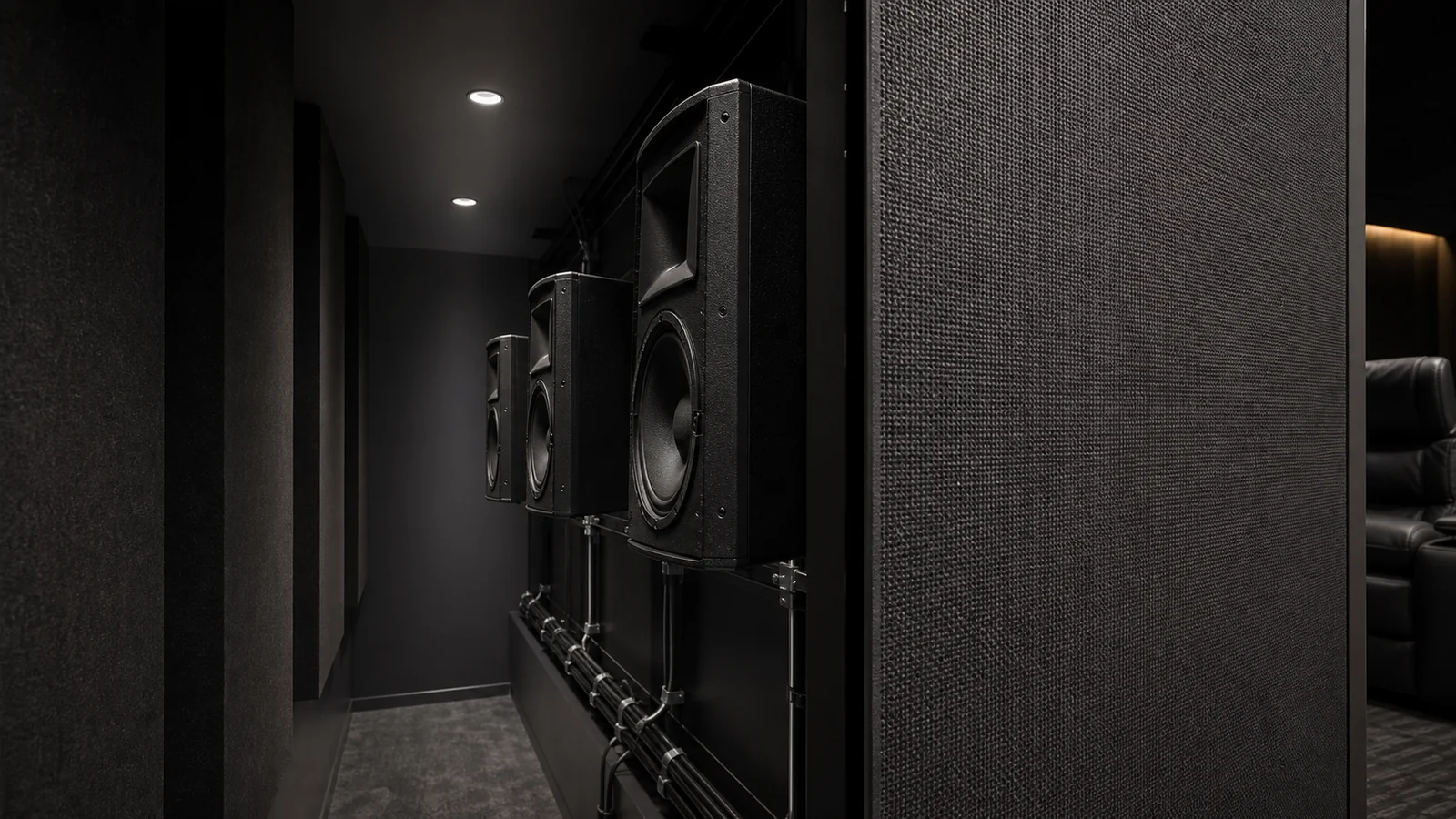
Do not press speaker grilles directly against the screen. Follow the loudspeaker and material supplier's spacing guidance, keep the screen clear of vibration and provide access for alignment and service.
2. Image Brightness
Openings that pass sound also mean the surface is not optically solid. Some projected light can pass through or scatter. Account for this when sizing the image and projector, but do not apply a universal brightness-loss percentage: it varies by material construction.
Use the verification sequence in our projector pairing guide and compare a sample under the intended image size and light conditions.
3. Texture Visibility
Sit at the nearest planned seat and view bright, mid-tone and detailed content. If the weave or perforations become part of the picture, either increase viewing distance, choose a finer structure or reduce image size. Product photography and subtitles often reveal texture sooner than dark cinema scenes.
4. Moiré
Moiré is an interference pattern created when the projector's pixel grid interacts with a regular weave or perforation pattern. It depends on projector technology, image scale, focus and material orientation. A sample tested with the actual projector is the reliable check; a still photograph of the material is not.
5. Light Behind the Screen
A bright wall, reflective speaker cones or equipment indicators behind an open material can show through or reduce perceived contrast. The front wall is commonly treated dark, and stray light sources should be removed. Any backing layer must be approved for the material because it can change acoustic performance.
Fixed Frame or Retractable?
Fixed-frame screens provide continuous tension and make the speaker wall easy to design as one system. They are the usual starting point for dedicated theaters. Compare available frame choices on MGF's fixed-frame screen category.
A retractable acoustic surface can suit a multipurpose room, but rolling, tensioning and material compatibility require more care. Confirm that the exact acoustic material is approved for the selected motorized or tab-tension structure. Our fixed frame vs motorized guide explains the broader room trade-off.
Sample Approval Test
Use a sample large enough to judge pattern and focus, then evaluate:
- the nearest and widest seating positions;
- the actual projector and representative content;
- visible texture and moiré;
- color and brightness compared with the reference surface;
- speaker response before and after room calibration;
- black backing, speaker spacing and service access;
- compatibility with the proposed frame or tension system.
Record the sample code and approval conditions in the order specification so the production surface is not substituted by description alone.
FAQ
Does an acoustic transparent screen reduce sound quality?
It changes sound transmission to some degree, but the effect depends on the material, speaker placement and calibration. Evaluate material-specific data and test the intended system instead of applying one universal figure.
Is woven or perforated material better?
Neither is automatically better. Woven and perforated surfaces have different texture, moiré and acoustic behavior. The projector, nearest seat and speaker system determine the better fit.
How far should speakers be behind the screen?
Follow the speaker and material supplier's guidance for the exact system. Leave enough clearance to prevent contact or vibration and to preserve access; do not assume one spacing suits every fabric and loudspeaker.
Can an acoustic transparent surface be used on a motorized screen?
Selected materials can be used with compatible tensioned or retractable structures, but not every acoustic surface is suitable for rolling. Confirm the exact material-and-product combination before ordering.
How do I prevent moiré?
Test the exact projector, image size, focus and material sample. A finer or differently oriented structure, greater viewing distance or adjusted image scale may help, but sample testing is the dependable decision method.
Confirm the Material With Your Theater Design
Send MGF your visible image size, projector model, nearest seating distance, speaker layout, screen structure and preferred material direction. MGF can confirm available acoustic transparent options and prepare the project for sample approval.
Ask MGF about acoustic transparent screen options.
---