ALR vs CLR vs UST Projection Screens: What Is the Difference?
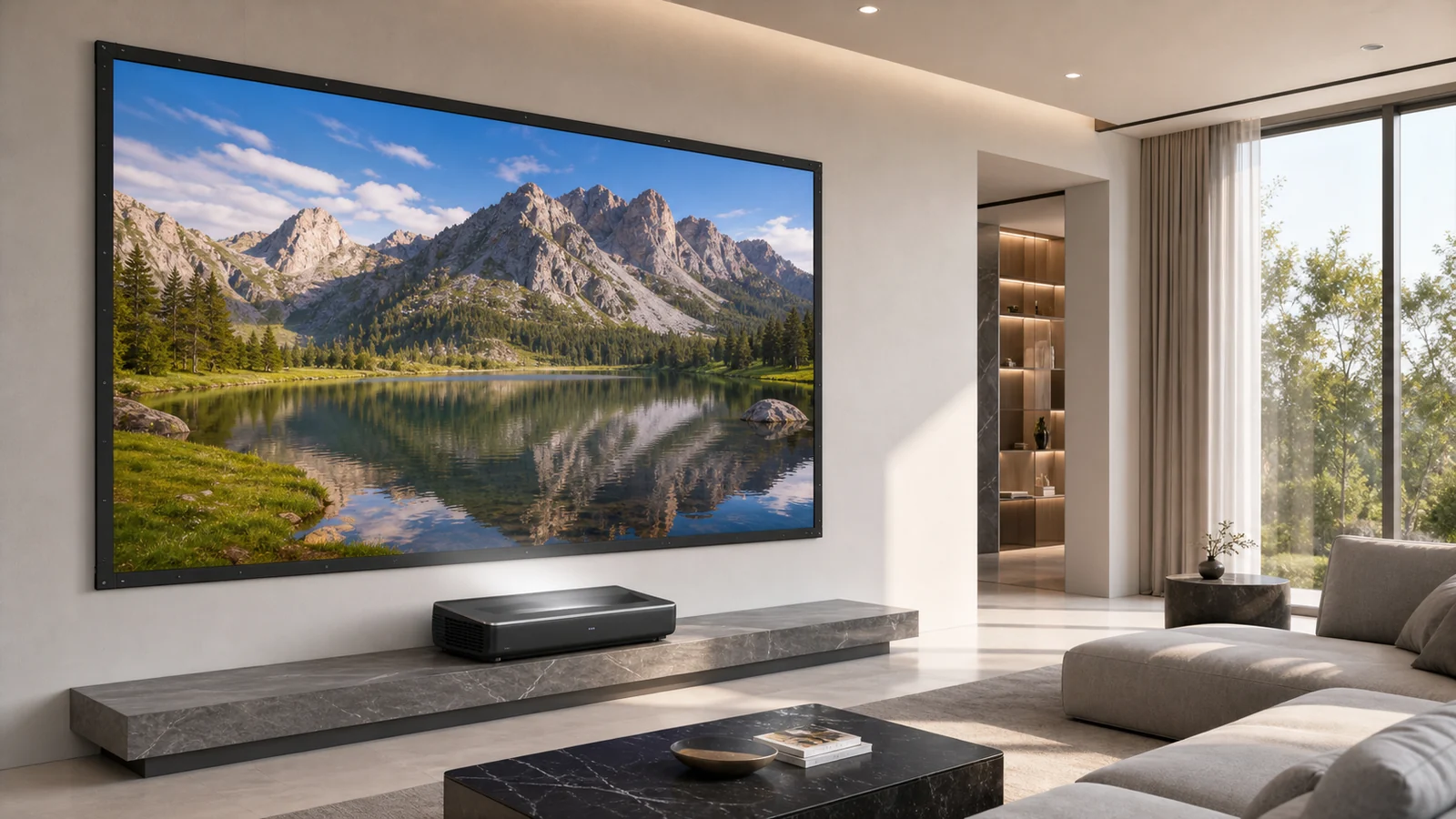
ALR, CLR and UST are often placed beside each other as if they were three equivalent screen grades. They are not. ALR describes a broad performance goal, CLR is a market term commonly used for rejecting light from above, and UST describes the projector's ultra-short-throw geometry. A single surface may be marketed with more than one of these terms.
The safe way to choose is to ignore the label for a moment and map three directions: where projector light arrives, where unwanted room light arrives and where viewers sit.
In This Guide
Definitions Without the Marketing Shortcuts
ALR: Ambient Light Rejecting
An ALR surface is designed to direct more of the intended projector light toward viewers while reducing selected off-axis ambient light. Different optical structures accomplish this in different ways, so “ALR” alone does not specify projector compatibility, rejection direction or viewing cone.
CLR: Ceiling Light Rejecting
CLR is commonly used in the market for surfaces intended to reduce light arriving from above, such as ceiling fixtures. It is not a single universal material standard. Ask for a diagram or written specification showing which light directions the exact surface accepts and rejects.
UST Screen or UST ALR
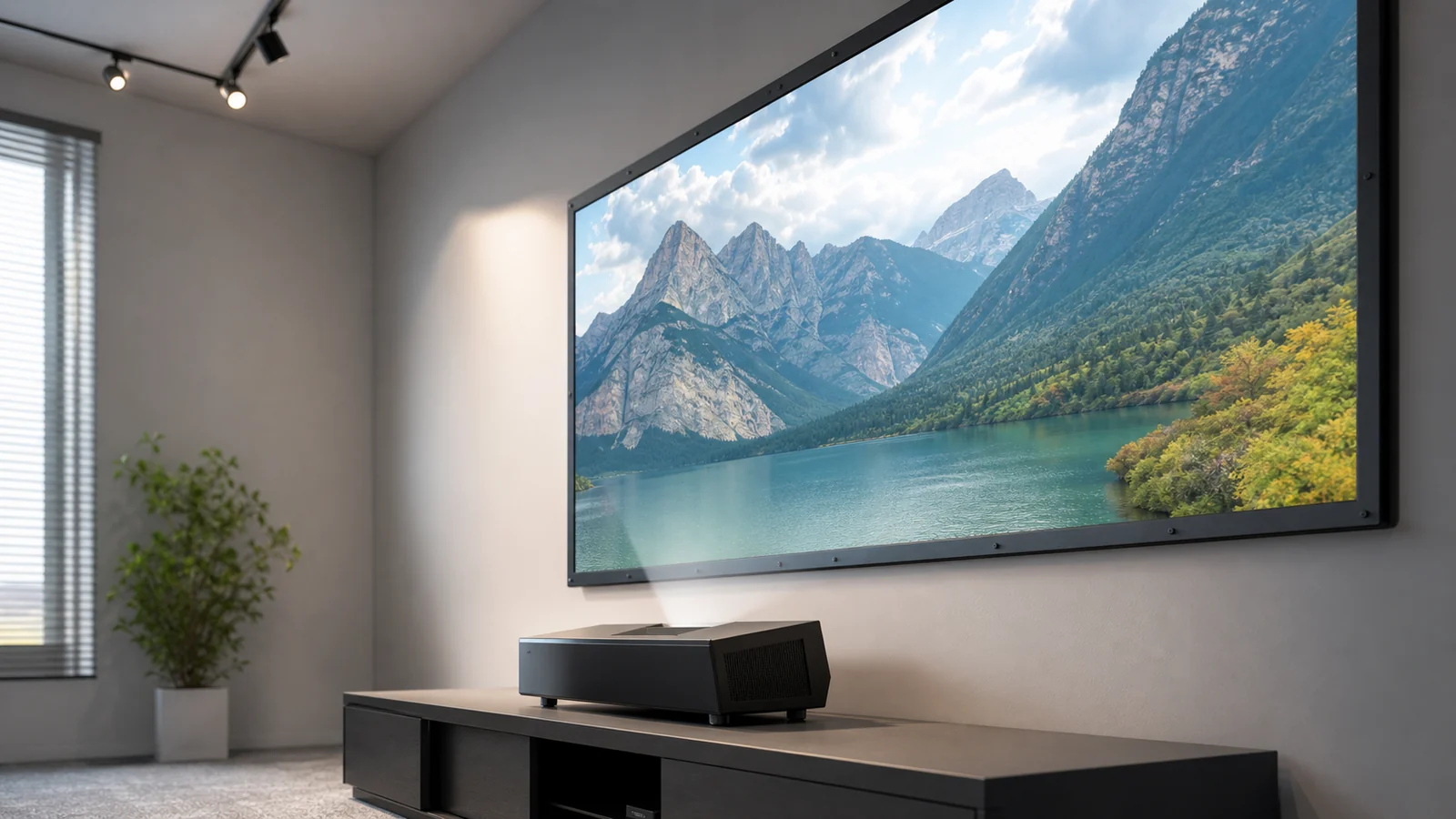
A UST-oriented surface is designed for light arriving steeply from an ultra-short-throw projector located close below or above the image. Its directional structure must be installed in the correct orientation. A material designed for a conventional projector may reject the UST projector's light; a UST material may perform poorly with a long-throw projector.
Comparison at a Glance
| Term | What it tells you | What it does not tell you | Critical confirmation |
|---|---|---|---|
| ALR | Surface manages selected ambient-light directions | Which projector geometry is accepted | Projector position and rejection diagram |
| CLR | Usually targets overhead light | Universal performance or standard test method | Exact accepted/rejected light directions |
| UST ALR | Designed around ultra-short-throw input geometry | Compatibility with every UST model or mounting direction | Projector placement, surface orientation and frame |
| Matte white | Broad, diffuse reference behavior | Performance in uncontrolled direct light | Room light control and projector brightness |
Why Projector Direction Comes First
Conventional projectors usually send light from farther back at a relatively shallow angle. UST projectors send light from very close to the screen at a steep angle. Directional surfaces distinguish between those rays.
Before choosing a material, record:
- projector model and lens type;
- below-screen, above-screen or rear placement;
- throw distance and image width;
- screen orientation and black-border direction;
- whether the material supplier confirms that geometry.
Use our projector brightness and throw-ratio guide to verify the basic image geometry before comparing material samples.
Map the Ambient Light
Light-rejecting surfaces do not make room light disappear. They respond to direction. Ceiling downlights, side windows and light reflected from the floor reach the screen differently.
- Remove or redirect any light aimed directly at the image.
- Note the strongest remaining light direction at the actual viewing time.
- Compare that direction with the surface's acceptance and rejection behavior.
- Check side seats; directional performance can trade viewing width for contrast.
If the room can be darkened reliably and the audience is wide, matte white may remain the most predictable choice. The broader comparison is in our ALR vs matte white guide.
Flatness and Structure Matter More With UST
UST light travels across the surface at a steep angle, so small waves can produce visible geometric distortion or uneven brightness. A rigid fixed-frame surface is often the simplest route. A retractable UST surface needs an appropriate material and tension system, careful leveling and a confirmed product configuration.
Do not attach a specialized material to a frame in the wrong orientation or rotate it to fit a cut. Treat the “top” direction as part of the specification and packaging label.
How to Approve a Material Sample
Evaluate the exact sample with:
- the intended projector and mounting direction;
- representative day and evening light;
- center and widest seating positions;
- bright, dark and uniform-color content;
- the planned image size and focus;
- the proposed fixed or tensioned structure.
Look for perceived contrast, color neutrality, hotspotting, sparkle, texture, viewing-cone change and sensitivity to vertical alignment. Our gain and viewing-angle guide explains why a brighter center is not automatically a better image.
MGF product information lists PVC ambient-light-rejecting, grey metallic and black-grid UST ALR materials across selected fixed-frame and tensioned products. The exact name, projector compatibility and available screen structure must be confirmed for the order.
Common Specification Mistakes
- Writing only “ALR screen” in an RFQ;
- pairing a conventional-projector ALR surface with a UST projector;
- assuming CLR is a standardized performance class;
- leaving the surface orientation unmarked;
- approving a sample under different lighting from the final room;
- ignoring side viewers and vertical projector alignment;
- choosing material before confirming screen flatness and structure.
FAQ
Is CLR different from ALR?
CLR is generally used as a more specific marketing description for rejecting overhead light, while ALR is the broader category. Because CLR is not one universal technical standard, confirm the exact surface behavior.
Does every UST projector need a UST ALR screen?
Not always. In a controlled dark room, a compatible diffuse surface may work. UST ALR becomes valuable where directional ambient-light management is needed, but flatness and geometry must still be correct.
Can a UST ALR screen work with a normal projector?
Often not as intended. A surface designed to accept steep UST light may reject light arriving from a conventional projector position. Use only a pairing confirmed by the material supplier.
Can UST ALR material be motorized?
Selected UST-compatible materials can be built into suitable tensioned retractable systems. Confirm rolling compatibility, tension structure, size limits and orientation for the exact configuration.
Is a higher-gain ALR screen always better in a bright room?
No. Directional brightness can introduce a narrower viewing cone, hotspotting, sparkle or placement sensitivity. Evaluate the complete room and sample rather than one gain value.
Confirm Projector, Light and Surface as One System
Send MGF your projector model, mounting position, image size, room-light directions, audience layout and preferred screen structure. MGF can confirm which listed material options are available for the selected product and arrange a sample-based approval path.
Confirm a screen material for your projector.
---