ALR vs Matte White Projection Screens: Which Fits Your Room?
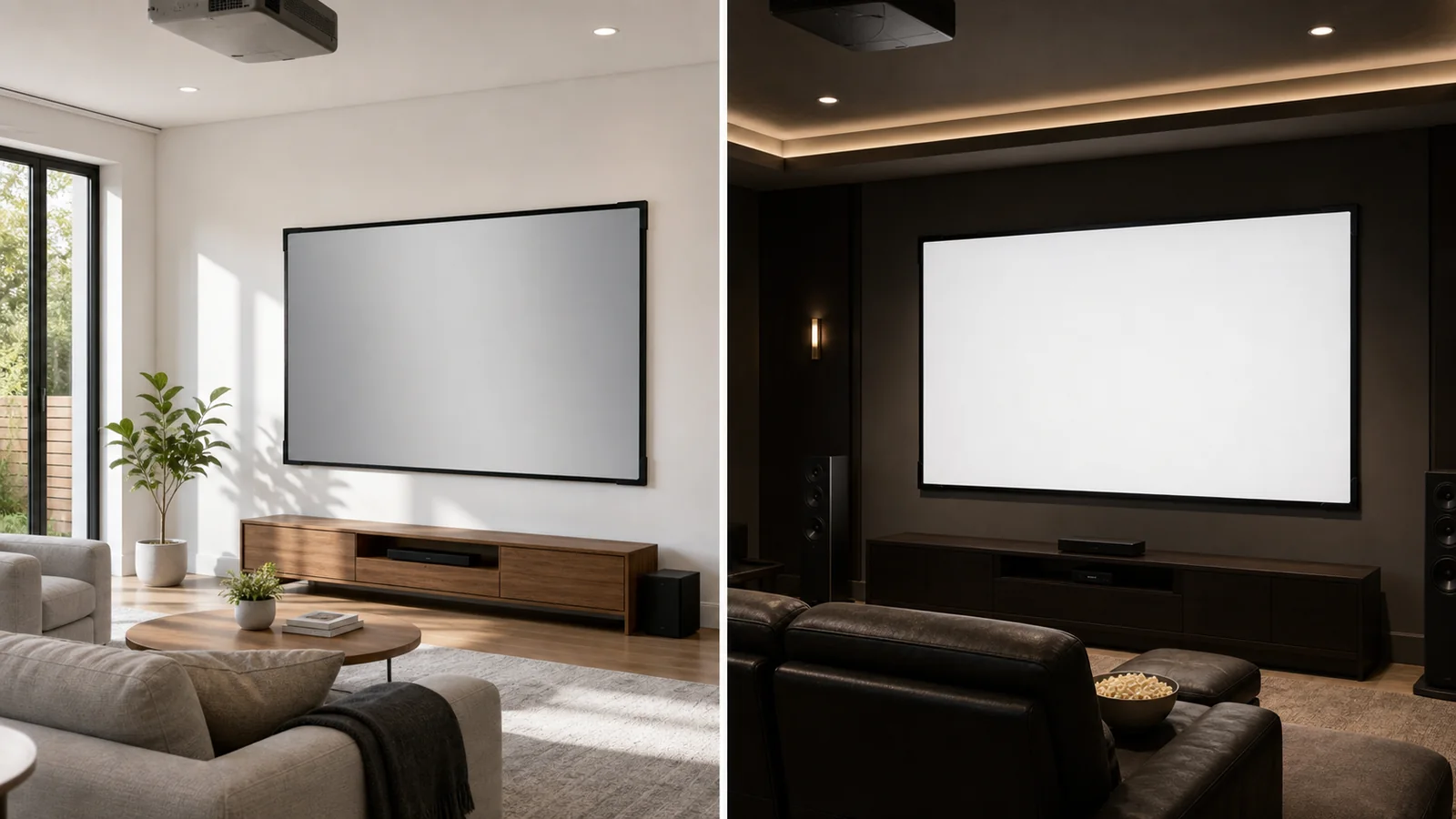
An ALR screen is not automatically better than a matte white screen. ALR materials can improve perceived contrast when unwanted room light comes from directions the surface is designed to reject, but they require careful projector, throw, seating and orientation matching. A well-specified white surface often provides wider viewing, more even brightness and simpler installation in controlled-light rooms.
The correct decision begins with the room and projector—not with a material label. Record the light direction, projector position, throw type, seating width, image size and content before comparing samples.
In This Guide
Quick Comparison
Swipe to compare columns.
| Decision factor | ALR material | Matte white / white surface |
|---|---|---|
| Best starting environment | Rooms with unavoidable directional ambient light | Rooms with good light control |
| Contrast in ambient light | Can improve perceived contrast when correctly oriented | More affected by light falling on the screen |
| Viewing cone | Often more directional and material-dependent | Usually more forgiving for wide seating |
| Projector compatibility | Must match standard-, short- or ultra-short-throw geometry | Broad compatibility, subject to product structure |
| Image uniformity | Can show hotspotting or brightness shift if mismatched | Often more uniform across the image |
| Installation sensitivity | Surface direction and orientation are critical | Generally simpler to orient and commission |
| Budget | Commonly higher | Often more economical |
| Sample testing | Strongly recommended | Recommended for important projects |
What “ALR” Actually Means
ALR means ambient light rejecting. The surface is engineered to direct more projector light toward the audience while redirecting some off-axis room light away from the viewing area. It does not remove light from the room, replace window treatment or increase the projector’s lumen output.
Different ALR structures solve different optical problems. A surface designed for a ceiling-mounted long-throw projector may not work correctly with a projector placed close to the screen. Ultra-short-throw systems commonly use a directional, microstructured material that accepts light arriving from below while rejecting more light from above. Installing that surface upside down can severely reduce the intended effect.
Use the MGF material catalog to check the recorded material name and compatible screen model. A black-grid or ALR label alone does not establish short-throw or UST compatibility. Confirm the exact projector geometry, material orientation and supplied configuration before sample approval.
What Buyers Mean by “Matte White”
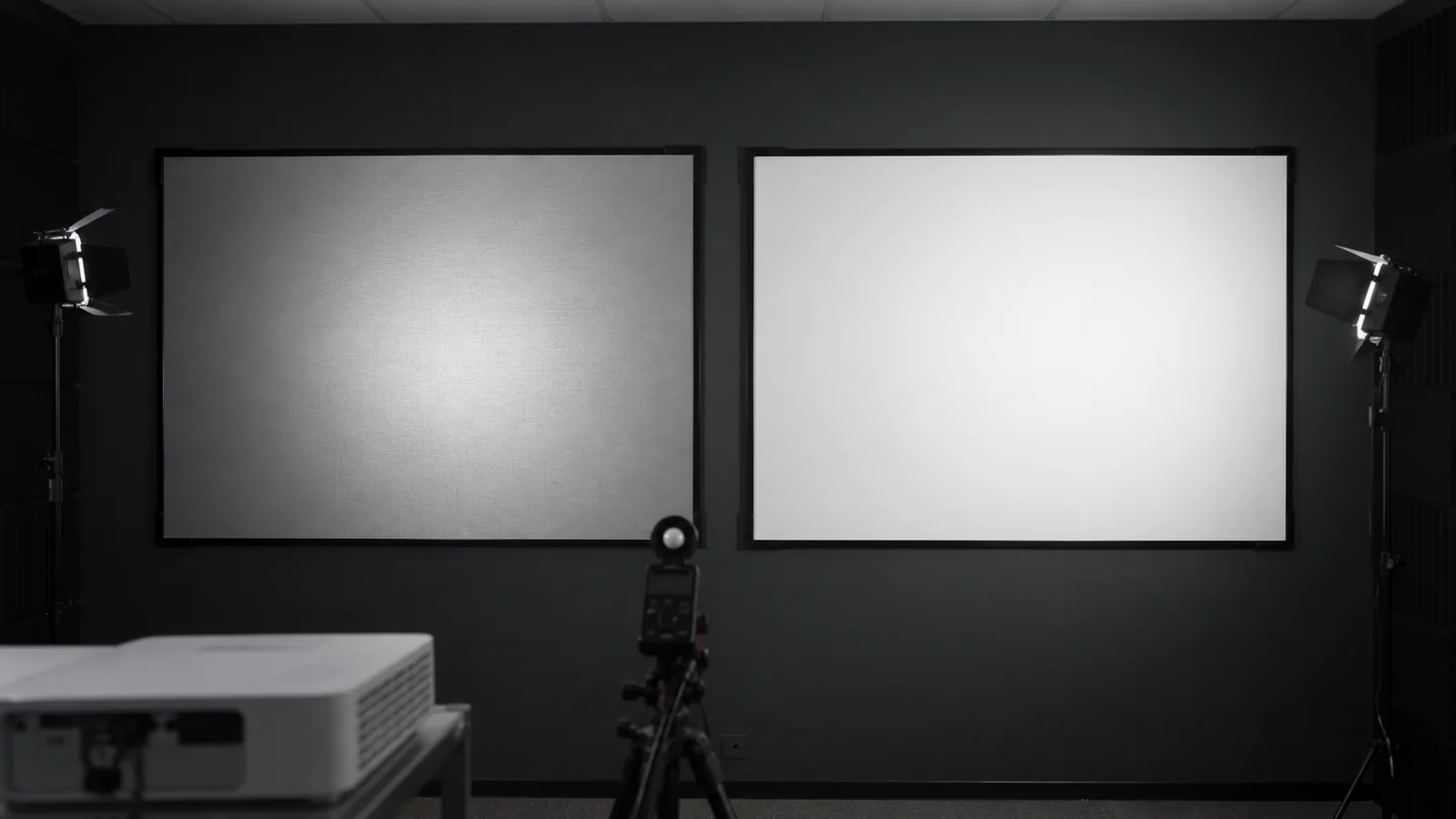
“Matte white” is often used as a broad market term for a neutral white projection surface. In a real quotation, however, the buyer should identify the actual construction.
MGF’s supplied product data distinguishes several white directions:
- White PVC Fabric 1000D: a basic white surface listed for selected standard electric and manual screens;
- White Fiberglass Fabric: a common white surface direction for multiple electric screen formats;
- PVC Soft White Fabric: a flexible white material used with selected tab-tensioned products;
- PVC White Fabric: a white surface direction for selected fixed-frame products.
These names should not be treated as interchangeable without checking thickness, backing, texture, product compatibility and intended tensioning method.
Seven Factors to Decide
1. Can the Room Light Be Controlled?
List every important source of light:
- windows and skylights;
- ceiling downlights;
- wall washers;
- table lights;
- illuminated signs or displays;
- light reflected from pale walls and ceilings.
Then record its direction relative to the screen. An ALR surface can reject only light arriving outside its acceptance direction. Light coming from the same direction as the projector is difficult to separate from the intended image.
If curtains, zoning or dimming can control the room during critical viewing, a white surface may provide a cleaner and more economical result.
2. What Projector Throw Type Is Used?
Confirm whether the projector is standard throw, short throw or ultra-short throw. The incident angle at the screen changes dramatically between these categories.
Never approve a generic ALR material before the final projector model and mounting position are known. For UST, confirm:
- material is designed for UST geometry;
- the correct side faces the audience;
- the top and bottom orientation is marked;
- the frame keeps the surface flat;
- the planned image size fits the projector’s lens specification.
3. How Wide Is the Seating Area?
Directional surfaces may trade a narrower viewing cone for better control of ambient light. Check the leftmost and rightmost seats, not only the center seat.
Use a full-size or sufficiently large sample with the intended projector. Move through the real seating positions and look for changes in brightness, color and contrast.
4. Is Uniformity More Important Than Ambient-Light Performance?
For color review, detailed graphics, shared work or wide seating, uniformity can matter more than maximum center contrast. Evaluate:
- center-to-edge brightness;
- hotspotting;
- color shift across viewing positions;
- visible surface texture;
- sparkle or sheen on bright content;
- moiré risk with the intended resolution and viewing distance.
Avoid selecting a material from one dark movie scene. Test white slides, skin tones, spreadsheets, gradients and moving images.
5. Can the Product Hold the Surface Flat?
Material selection and screen structure are connected. A fixed frame applies perimeter tension continuously. A tab-tensioned retractable screen adds side tension to a flexible surface. A standard roll-down screen relies mainly on the roller, surface weight and bottom bar.
For directional or UST materials, small geometric variations may be more visible because the projector light arrives at a steep angle. Review MGF’s fixed-frame projection screens and tab-tension screen options according to the installation requirement.
6. What Is the Real Operating Condition?
Ask whether the room is used for:
- films in controlled darkness;
- daytime TV and sports;
- presentations with lights on;
- spreadsheets and technical drawings;
- mixed home and business use.
For a dedicated dark theater, a neutral white surface may be the most predictable starting point. For a bright multipurpose living area, a compatible ALR material may be worth testing. For a conference room, light control and adequate projector brightness often remain essential even when ALR is considered.
7. What Is the Total Project Cost?
Compare more than material price. Include:
- compatible screen structure;
- projector output and throw type;
- room-light treatment;
- installation and alignment time;
- sample evaluation;
- replacement and maintenance access.
A more expensive surface cannot correct an undersized projector, uncontrolled light arriving from the wrong direction or incorrect installation.
Selection Matrix by Application
Swipe to compare columns.
| Application | Starting point | Upgrade or test when |
|---|---|---|
| Dedicated home theater | White fixed-frame surface | Dark-room contrast or acoustic requirements justify another material |
| Bright living room with UST | UST-compatible ALR fixed-frame surface | Always test projector/material combination and seating cone |
| Multipurpose living room with ceiling projector | White or compatible ALR tensioned surface | Directional room light cannot be controlled |
| Conference room | White fiberglass or suitable project surface | Lights must remain on and a compatible ALR sample performs better |
| Wide training room | Broad-viewing white surface | ALR does not reduce edge-seat brightness excessively |
For residential planning, see MGF’s home theater projection screen solutions. For business spaces, use the conference room application guide.
How to Evaluate a Material Sample
- Use the final projector model and approximate throw position.
- Test at the intended image brightness and room-light settings.
- Place the sample in the same vertical orientation as the finished screen.
- View from the center and extreme seating positions.
- Display bright slides, dark scenes, skin tones, fine text and gradients.
- Compare contrast, uniformity, texture and color—not only brightness.
- Photograph the setup only as a record; make the decision by direct viewing.
Document the sample name, orientation, projector, image size, room-light condition and viewer position so the result can be repeated.
Common Material-Selection Mistakes
- Treating every ALR material as suitable for every projector;
- assuming ALR makes a room-light plan unnecessary;
- using “matte white” without identifying the real material construction;
- judging only from the center seat;
- approving from a small online photo instead of a sample;
- installing a directional surface upside down;
- ignoring screen flatness for UST projection;
- comparing surfaces at different projector settings.
Separate Long-Throw ALR from UST/CLR Materials
Swipe to compare columns.
| Projector geometry | Material discussion | Main mismatch risk |
|---|---|---|
| Standard/long throw | Matte white or an ALR surface designed for the projector and room-light direction | Hotspotting, narrow seating coverage or rejection of useful projector light |
| Short throw | Confirm the exact throw ratio and approved material range | Uneven brightness or visible surface structure |
| Ultra-short throw | Use a material explicitly reviewed for UST/CLR geometry | A long-throw ALR surface can reject the steep projector light |
Compatibility checklist before quotation
- Projector brand/model, throw ratio, lens position and mounting orientation
- Visible image dimensions, aspect ratio and screen structure
- Direction and operating hours of daylight and task lighting
- Center, nearest and widest seating positions
- Content mix: text, charts, video, cinema and dark scenes
- Approved material code based on a real sample test
“ALR” is a material behavior, not a universal compatibility label. The projector geometry and incident-light direction must be reviewed together.
ALR and White-Surface Sample Test Matrix
Record the actual material name, gain, half-gain angle or viewing-angle specification supplied for the sample. Do not substitute a generic ALR label or an unverified number.
Swipe to compare columns.
| Test field | ALR sample | Matte-white sample | Pass / fail decision rule |
|---|---|---|---|
| Projector type and direction | standard / short / UST; incident direction: ____ | standard / short / UST; incident direction: ____ | Pass only when the material is approved for the exact projector geometry and orientation. |
| Gain and half-gain / viewing-angle data | supplier value: ____ / ____ | supplier value: ____ / ____ | Record the supplied figures; compare center and edge seats against the project viewing cone. |
| Seating positions | center / left edge / right edge / rear: ____ | center / left edge / right edge / rear: ____ | Pass only when required seats retain acceptable brightness, color and contrast. |
| Test content | white slide, skin tones, dark scene, text, gradient, motion | white slide, skin tones, dark scene, text, gradient, motion | Reject if hotspotting, sparkle, texture, color shift, moiré or edge-seat loss exceeds the agreed tolerance. |
| Room-light direction | source and angle: ____ | source and angle: ____ | Document whether the ALR rejection direction actually matches the unwanted light. |
| Orientation and sample record | top / bottom / audience side: ____; date: ____ | top / bottom / audience side: ____; date: ____ | Repeat the test with the same brightness, image size, orientation and room-light setting before approval. |
Related Planning Resources
FAQ
Is an ALR screen always better in a bright room?
No. Its performance depends on where the unwanted light comes from, how the material directs projector light and where the audience sits. Light arriving near the projector direction may not be rejected effectively.
Can I use a UST ALR screen with a ceiling projector?
Do not assume so. UST ALR surfaces are typically directional and designed for steep light arriving from a particular direction. Confirm the exact material and projector geometry.
Does a matte white screen need a dark room?
It performs best with controlled light, but the acceptable condition depends on projector brightness, image size, content and room design. Many meeting and training rooms use white surfaces with managed lighting.
Is ALR suitable for wide seating?
Some ALR materials have a more restricted viewing cone than neutral white surfaces. Test the extreme seats before approval.
Should I choose the material before the screen type?
Choose them together. Some materials require fixed-frame or tab-tension structures, while other materials are suitable for standard retractable screens.
Material availability depends on the selected configuration; review fixed frame projection screen material directions before specifying the project.
Request a Material Recommendation
Shortlist a surface in the material catalog and product compatibility list, then send its name or code with the projector model, image size, screen structure, room-light photos and seating layout. State whether you need a finished screen, replacement surface or material-only supply, plus quantity and destination. Confirm roll or cut format, width, sample availability, cost and timing for the selected material before ordering.
Contact MGF Screens for a projection screen material and product recommendation