Projector Mount vs Projector Lift: Which Installation Hardware Do You Need?
---
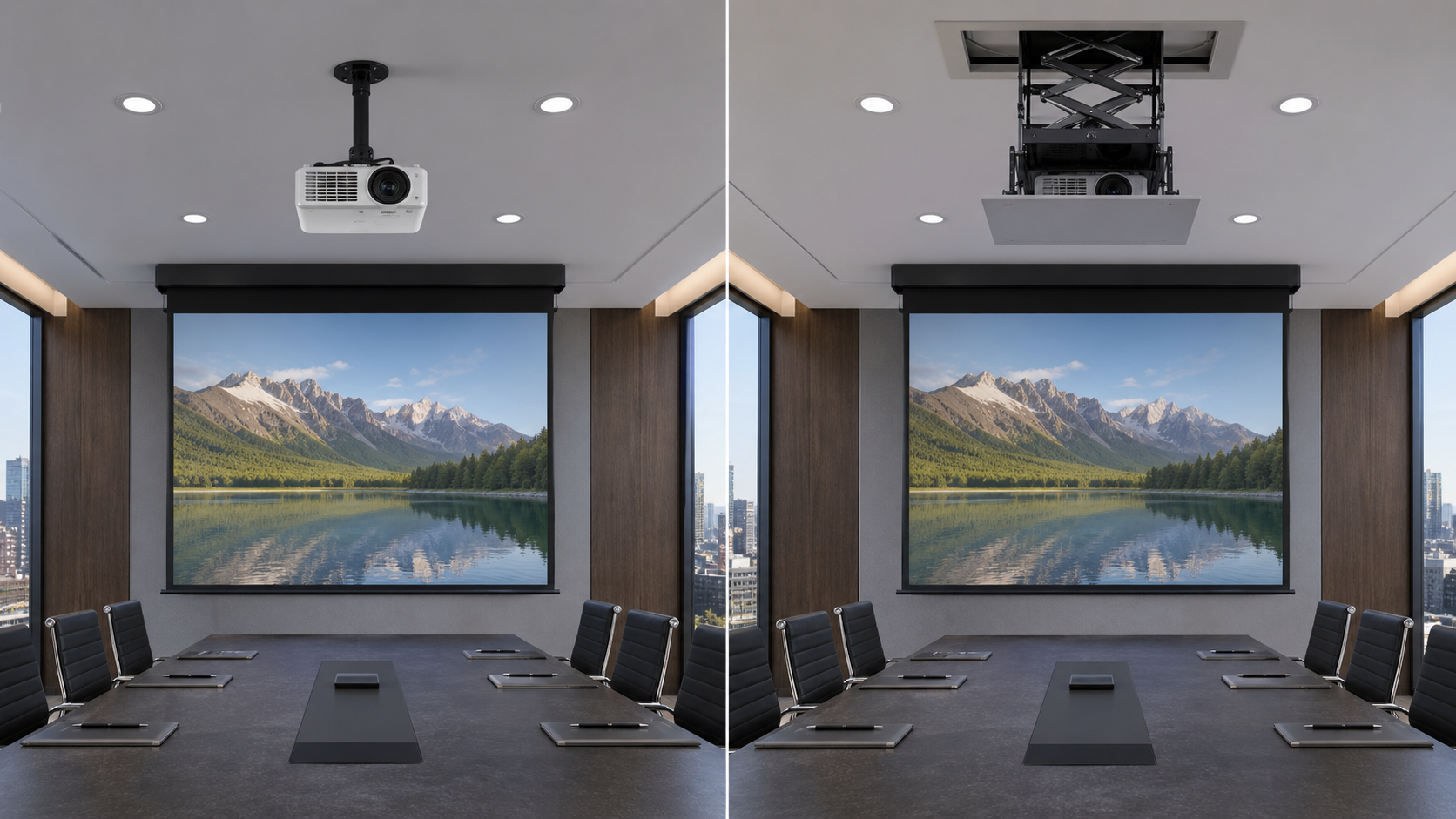
A projector mount holds the projector in a fixed position. A projector lift moves or conceals it. Both can work with a motorized projection screen, but they solve different room, access and architectural requirements.
The correct choice depends on the projector, lens geometry, ceiling structure, service route, control system, visibility requirement and maintenance plan. This guide avoids making a load or compatibility claim without the exact hardware model.
In This Guide
Quick Answer
Choose a fixed mount when the projector can remain visible and the room has a stable ceiling fixing point. Consider a lift when the projector must disappear, descend for service or share a concealed AV installation. The final decision still requires a model drawing and load confirmation.
Use the In-Ceiling Electric Projection Screen page as a related screen product link and the Installation & Troubleshooting Hub for coordination context. The accessories themselves should be linked to the final projector-mount product pages once those pages are live.
Who This Guide Is For
This guide is for AV integrators, distributors, contractors and project buyers who need a documented selection and project-planning path for this topic before requesting a quotation.
Fixed Projector Mount
A fixed mount can provide a simple, repeatable projector position. It may suit a conference room, classroom, showroom or home theater where the projector can remain in the room and service access is straightforward.
Confirm ceiling structure, fixing method, projector orientation, lens shift, cable route, ventilation and adjustment access. The projector position must be coordinated with the screen image, throw ratio and aspect ratio. See the projector pairing guide before finalizing the mount.
Projector Lift
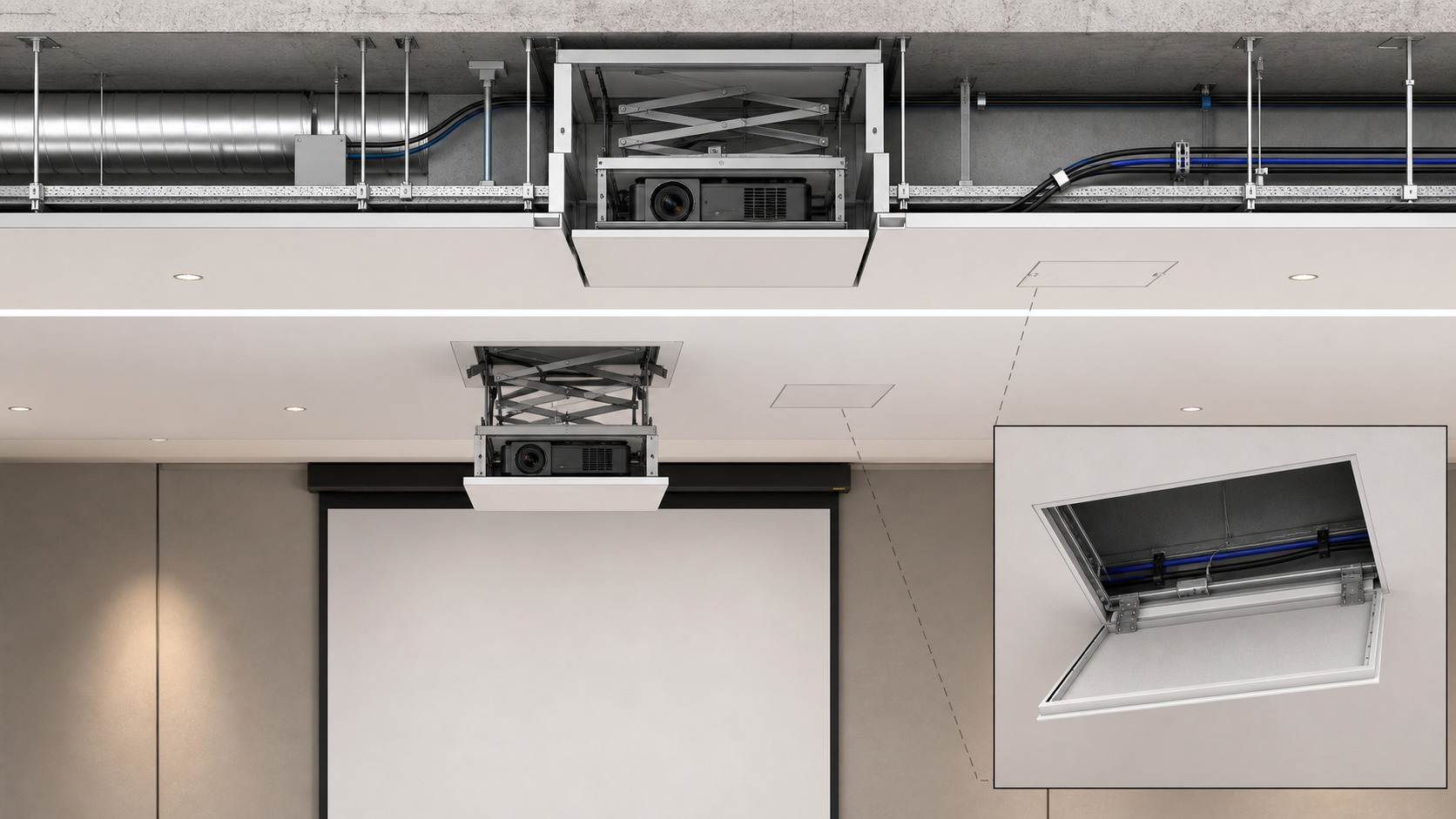
A lift can be considered when the projector must be concealed, lowered for use or integrated into a ceiling detail. It adds moving parts, control, clearances and a service route. The ceiling closure must not prevent inspection or replacement.
Request the lift envelope, travel, fixing structure, cable flex route, control interface and approved projector orientation. Confirm how the unit stops, how it is isolated and how the installer reaches it for maintenance.
Comparison Table
| Decision point | Fixed mount | Projector lift |
|---|---|---|
| Projector visibility | Remains visible | Can be concealed, model dependent |
| Mechanical movement | None after alignment | Moving mechanism and limits |
| Ceiling planning | Structure and cables | Structure, lift envelope, access and cables |
| Control | Usually simple | Requires movement control and commissioning |
| Service | Direct access if visible | Access panel or service position required |
| Main risk | Wrong alignment or fixing | Clearance, load, control or access mismatch |
Coordinate the Projector With the Screen
The mount or lift is only one part of the image system. Confirm screen type, image size, material, throw distance, lens position and viewing layout. A fixed frame screen may need a different projector position from an electric screen.
For a conference room, use the Conference Room application page. For commercial or showroom use, connect the project to Commercial Display.
Engineering and Handover Checklist
Include:
- projector model and total installed weight;
- lens and throw geometry;
- ceiling construction and fixing method;
- mount or lift envelope;
- cable and flex route;
- control method and local override;
- ventilation and service access;
- screen image and final alignment;
- commissioning and acceptance record.
For factory and OEM project context, see Factory & Production. Send the projector, screen and ceiling information through Contact.
MGF Product Direction
MGF can compare suitable product directions once the project brief confirms visible image size, aspect ratio, projector geometry, material direction, mounting condition, control requirements, quantity and destination market. The final quotation should identify the exact model, compatible material, drawing and approval information rather than treating a generic guide as a product specification.
Project / OEM Checklist
- visible image width, height and aspect ratio;
- projector model, lens position and image geometry;
- room or venue use, seating and ambient-light condition;
- proposed material, structure, mounting and service access;
- power, control and installation responsibility where relevant;
- required quantity, destination market, drawing revision and approval owner.
Continue Your Project Planning
- Screen Selection Guides
- Electric Projection Screens
- Fixed Frame Projection Screens
- Conference Room Applications
- Factory & Production
- Projection Screen Size and Aspect Ratio Guide
- Contact MGF Screens
FAQ
Is a projector lift safer than a fixed mount?
Safety depends on the exact product, ceiling structure, installation and commissioning. Do not rank them without the model and site review.
Can a lift hide any projector?
No. Confirm dimensions, weight, orientation, ventilation, cable flex and control compatibility.
Does the screen determine the projector mount?
The screen and projector must be coordinated, but the mount or lift also depends on the ceiling and projector requirements.
What must be approved before closing the ceiling?
Approve the lift envelope, fixing, cable route, service access, control, screen alignment and acceptance procedure.
Request a Projector Hardware Review
Send the projector model, weight, lens information, ceiling drawing, screen size and control method to MGF Screens or the responsible AV integrator. Confirm the final accessory model before installation.