Curved Fixed Frame Projection Screen Guide for Large Venues
---
In This Guide
Quick Answer
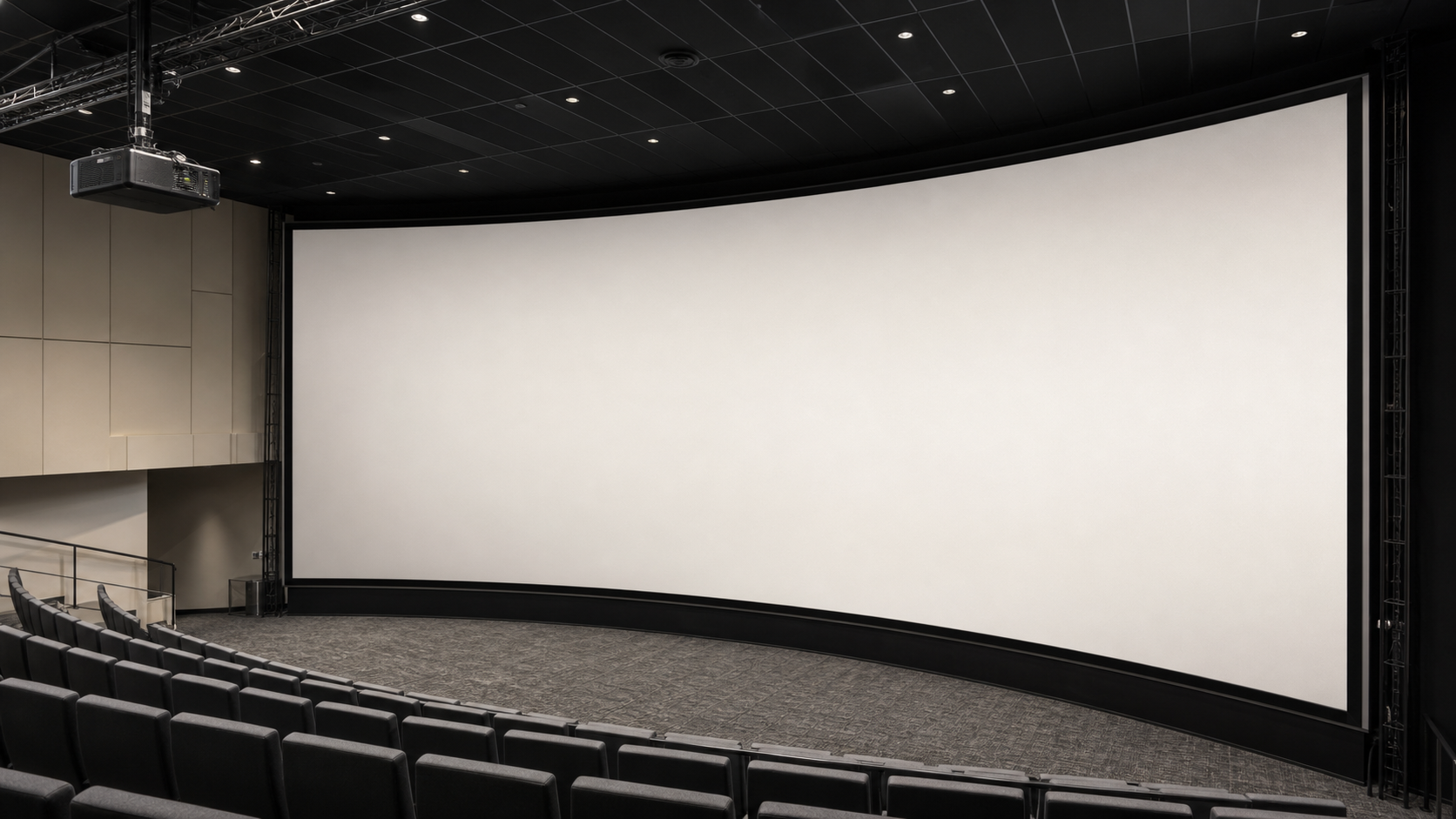
A curved fixed frame projection screen can be considered for large-format venues where the room, seating layout and image geometry call for more than a flat wall-mounted screen. The curved structure is not a decorative upgrade that can be selected after the projector. It changes how the screen, projector, sightlines, wall structure and material must be coordinated.
This guide is for AV integrators, contractors, venue planners and OEM project buyers preparing a large-screen request.
Who This Guide Is For
This guide is for AV integrators, distributors, contractors and project buyers who need a documented selection and project-planning path for this topic before requesting a quotation.
Begin With the Venue Geometry
Record the room length, width, ceiling height, stage or presentation zone, nearest and farthest seats, aisle positions and any obstructions. Mark the intended screen centerline and the audience sightlines before selecting the curve.
The project should also identify whether the screen is used for cinema content, presentations, simulation, events or a mixed program. A large screen for a commercial venue may have different image-height and maintenance requirements from a dedicated cinema.
For a commercial application, start with the Commercial Display solutions. For a dedicated home theater or media room, compare the Home Theater application and confirm whether a curved surface is appropriate for the projector and content system.
Why Consider a Curved Screen?
A curved screen may help a project create a wider visual presence or coordinate the image with a particular room layout. The benefit depends on the curve, projector lens, image mapping, viewer positions and surface construction.
Do not promise a universal immersion, brightness or viewing-angle improvement. Instead, define the project’s intended visual result and ask the supplier and AV integrator to verify the geometry with the proposed projector system.
Flat vs Curved Fixed Frame
| Decision point | Flat fixed frame | Curved fixed frame |
|---|---|---|
| Wall requirement | Flat, stable wall | Engineered support or shaped structure |
| Projector planning | Standard image geometry | Lens and geometry require project review |
| Audience layout | Broad range of rooms | Best when the venue geometry justifies it |
| Installation | Simpler assembly and alignment | More detailed alignment and structural coordination |
| Material | Model dependent | Model and curve compatibility must be confirmed |
| Project documents | Standard elevation and fixing detail | Curvature, radius, support and installation drawings |
Confirm the Projector and Image Geometry
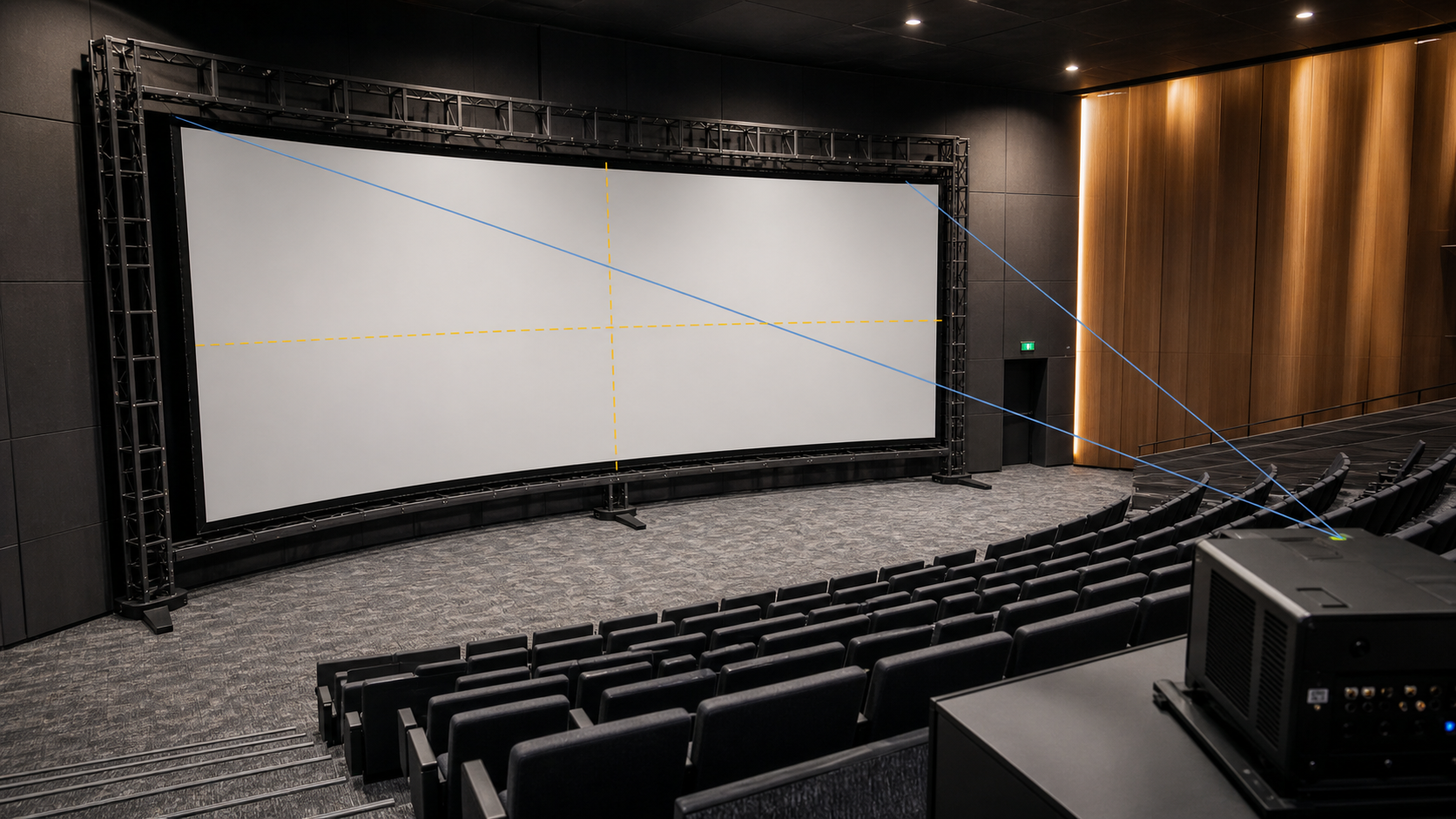
The projector model, lens shift, throw distance, image mapping and final image dimensions must be reviewed together. A curved screen can introduce geometry considerations that do not appear with a basic flat-wall installation.
Ask the integrator to confirm:
- projected image width and height;
- lens position and throw geometry;
- required curvature or radius;
- image warping or mapping approach, if applicable;
- focus uniformity across the surface;
- edge and center alignment;
- test procedure before final acceptance.
Use the projector brightness, throw ratio and screen pairing guide as a starting framework, then obtain model-specific engineering confirmation.
Select the Surface With the Curve
Not every screen material or frame construction should be assumed compatible with a curved structure. Matte white, grey, ALR and acoustic transparent materials each bring different optical or acoustic considerations.
For speaker-behind-screen designs, review the acoustic transparent projection screen guide and test image and audio performance together. For rooms with ambient light, use the Screen Materials Hub to plan a sample review.
The sample should be evaluated from actual or representative seats, not only from the centerline. Check texture, hotspotting, color neutrality, edge performance and any visible optical artifacts.
Acceptance Testing for a Curved Screen
The acceptance plan should be written before the frame arrives. Define the reference centerline, allowable alignment method, projector test pattern, seating positions and image checks. For an acoustic transparent installation, include a sound check with the speakers in their final position.
During installation, inspect the support structure, curve reference, frame joints, material attachment and image plane. After projector calibration, test focus and geometry across the center and edges. Record any approved masking, mapping or calibration settings with the model and drawing revision.
Large screens also need a maintenance route. Identify how the surface, frame, projector and speakers can be inspected without blocking the venue. For projects with multiple venues, keep the approved curve and material information in a shared project file so future replacements do not rely on memory.
Budget and Delivery Questions
Avoid comparing a curved screen and a flat screen only by purchase price. The project may also require engineered support, special packaging, assembly space, calibration time, transport protection and on-site acceptance. Ask the supplier to separate the screen, material, mounting, drawings and service assumptions in the quotation.
Structural and Installation Planning
A large curved frame may require more than a typical wall fixing. Confirm the substrate, support points, assembly access, installation sequence, final tolerance, protective packaging and replacement strategy.
The technical submission should show the image plane, frame shape, radius or curvature reference, mounting points, material, overall dimensions and access requirements. If the project is repeated across venues, keep the approved drawing and model name version-controlled.
MGF Screens’ Factory & Production page can serve as a trust link for manufacturing and inspection context. For a project or OEM request, send the full drawing package through Contact.
Large-Venue RFQ Checklist
Include:
- venue plan and seating layout;
- target image dimensions and aspect ratio;
- desired curve direction and reference radius;
- projector model, lens and throw information;
- material and acoustic requirement;
- wall or truss support condition;
- access, assembly and service constraints;
- packaging and transport route;
- drawing approval and on-site acceptance requirements.
MGF Product Direction
MGF can compare suitable product directions once the project brief confirms visible image size, aspect ratio, projector geometry, material direction, mounting condition, control requirements, quantity and destination market. The final quotation should identify the exact model, compatible material, drawing and approval information rather than treating a generic guide as a product specification.
Project / OEM Checklist
- visible image width, height and aspect ratio;
- projector model, lens position and image geometry;
- room or venue use, seating and ambient-light condition;
- proposed material, structure, mounting and service access;
- power, control and installation responsibility where relevant;
- required quantity, destination market, drawing revision and approval owner.
Continue Your Project Planning
- Screen Selection Guides
- Electric Projection Screens
- Fixed Frame Projection Screens
- Conference Room Applications
- Factory & Production
- Projection Screen Size and Aspect Ratio Guide
- Contact MGF Screens
FAQ
Is a curved screen always better for a large venue?
No. It is appropriate only when the venue geometry, projector system and project objective justify the added engineering coordination.
Can any fixed frame screen be bent into a curve?
No. The frame, material, support and installation system must be designed or approved for the intended curvature.
Does a curved screen remove the need for projector calibration?
No. Geometry, focus, mapping and alignment still need system-level calibration.
What is the most important document to request?
Request a current drawing that shows the image plane, curvature reference, overall dimensions, support points, material and installation requirements.
Request a Curved-Screen Engineering Review
Send the venue plan, seating layout, projector information, target image size and desired visual result to MGF Screens. A model and material should be selected only after the curve and installation can be documented.