How to Evaluate an OEM Projection Screen Manufacturer: 12 Checks for Distributors
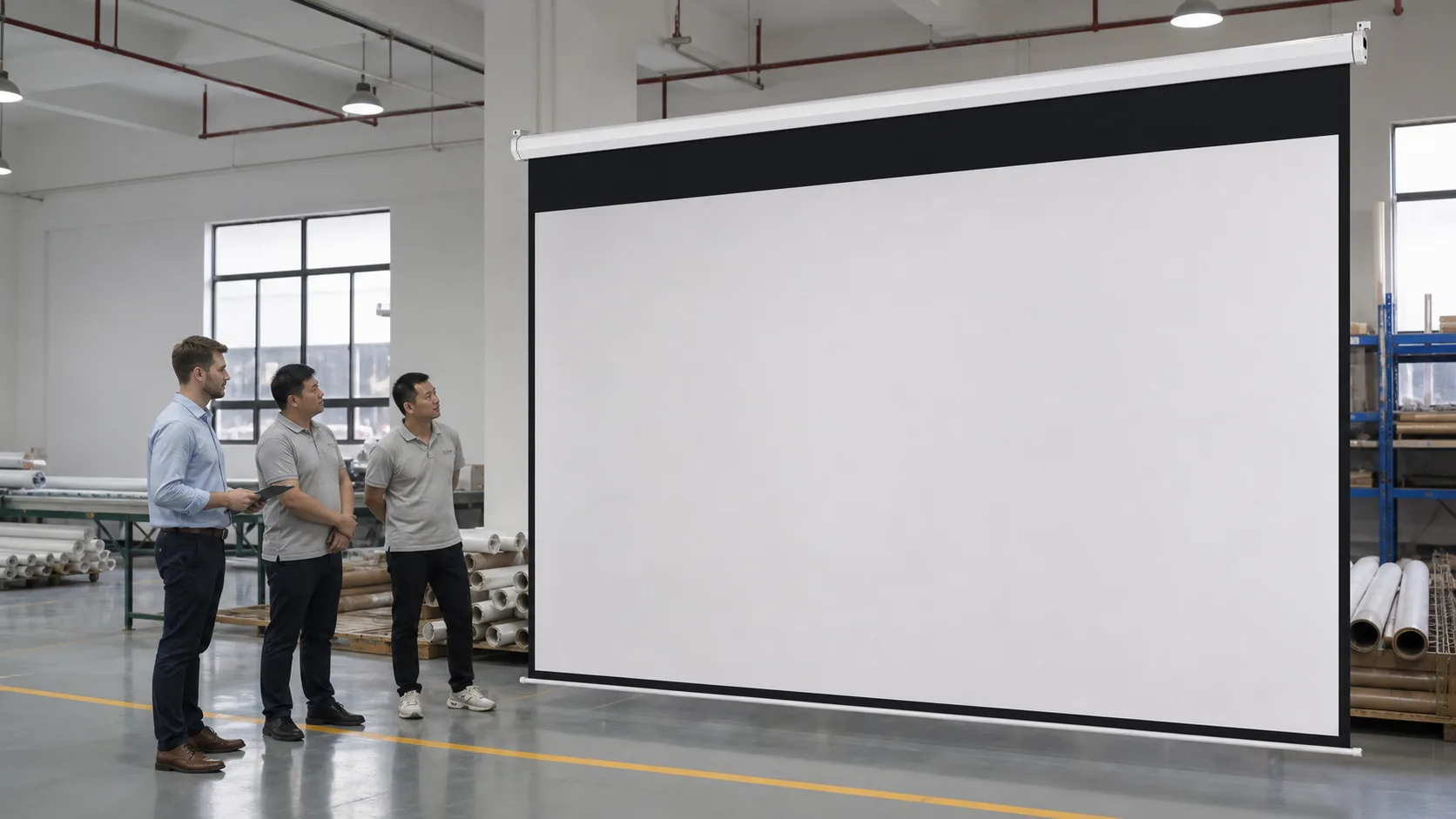
Choosing an OEM projection screen manufacturer is not simply a matter of comparing a price list. A reliable supplier must be able to match the screen to the application, manufacture it consistently, document what was agreed, protect it during transport, and support your team when a project changes.
For distributors and AV integrators, the strongest evaluation process combines document review, product sampling and factory-level verification. Start with the 12 checks below, then score every candidate against the same requirements. This makes it easier to distinguish a capable manufacturing partner from a trader offering a broad catalog without sufficient technical control.
In This Guide
Who This Guide Is For
This guide is designed for:
- projection screen distributors and wholesalers;
- AV integrators and installation companies;
- contractors sourcing screens for commercial or education projects;
- brands developing private-label projection screen ranges;
- procurement teams comparing factories for repeat orders.
If you only need one standard screen, a product-level comparison may be enough. If you need custom dimensions, different screen materials, branded packaging, multiple control options or repeatable project supply, supplier evaluation becomes part of product risk management.
The 12-Check Supplier Evaluation Scorecard
| Check | What to verify | Evidence to request |
|---|---|---|
| 1. Product fit | Required screen types and applications | Product matrix and relevant samples |
| 2. Manufacturing role | Factory, assembler or trading company | Factory profile, process photos and visit/video |
| 3. Engineering support | Ability to review dimensions, mounting and controls | Technical drawing and pre-production approval process |
| 4. Material options | Suitable surfaces for the projector and room | Material samples and current specifications |
| 5. Customization scope | Size, ratio, housing, color, control and packaging | Written customization checklist |
| 6. Sample process | Sample accuracy and feedback handling | Approved sample record and revision procedure |
| 7. Quality control | Incoming, in-process and final checks | Inspection checklist and test records |
| 8. Compliance | Documents relevant to product and destination | Current certificates and model scope |
| 9. Capacity | Ability to support forecast and peak orders | Capacity explanation and production plan |
| 10. Packaging | Protection for local and export transport | Packaging specification and drop/handling approach |
| 11. Order control | Clear specifications, changes and traceability | Order confirmation and change-control documents |
| 12. After-sales support | Response to defects, shortages and field issues | Written claim process and responsible contact |
1. Confirm Product–Market Fit Before Discussing Price
Begin with your sales channel and end-use applications. A manufacturer serving professional AV projects should be able to explain where each screen type fits—not merely send a catalog.
For example, a distributor may need a portfolio that includes electric projection screens, manual projection screens, fixed-frame screens and portable solutions. An integrator may instead prioritize recessed in-ceiling models, tab-tensioned surfaces and control compatibility.
Give the supplier a short application brief containing:
- target countries and customer type;
- projector type and throw ratio;
- expected screen sizes and aspect ratios;
- wall, ceiling, recessed or floor-rising installation;
- ambient-light conditions;
- control and integration requirements;
- forecast quantity and order frequency.
A good supplier should identify missing information before recommending a product.
2. Verify Who Actually Manufactures the Product
Ask whether the supplier owns the production facility, subcontracts major processes or only coordinates orders. None of these models is automatically unacceptable, but you need to know who controls the critical steps.
Review the supplier’s factory and production process and ask to see how fabric cutting, housing preparation, assembly, functional testing, inspection and packaging are handled. A live video walk-through or an independent factory audit is more useful than a set of polished factory images alone.
Also confirm which components are produced internally and which are purchased. The supplier should be able to explain how incoming motors, controls, fabrics and aluminum or steel parts are inspected.
3. Evaluate Engineering and Pre-Production Support
Projection screens are dimensional products. A small misunderstanding about viewing area, black drop, overall housing length, bracket position or ceiling opening can create a costly installation problem.
Before placing a production order, ask the manufacturer to issue a technical drawing or specification sheet showing the agreed:
- visible image width and height;
- diagonal size and aspect ratio;
- overall screen and housing dimensions;
- black border and drop dimensions;
- mounting points and clearance;
- motor side, power entry and control method;
- material and viewing orientation;
- packaging and label requirements.
The approval document should have a revision number. Verbal confirmation in a messaging app should not be the only production reference.
4. Test Screen Materials in the Intended Environment
“White,” “grey” and “ALR” are product families, not complete specifications. Material choice depends on projector brightness, throw type, ambient light, seating position, image size and acoustic requirements.
Request labeled material samples and test them with the projector type used by your customers. Check brightness uniformity, color neutrality, viewing angle, surface texture, visible sparkle or hotspotting, and compatibility with standard-throw or ultra-short-throw projection where relevant.
For acoustically transparent material, evaluate the complete system: image quality, perforation or weave visibility at the intended viewing distance, speaker placement and audio impact. Do not approve a material based only on a small desktop sample under office lighting.
5. Define the Real Customization Scope
OEM capability should be translated into a controlled list of options. Depending on the product, customization may include:
- viewing size and aspect ratio;
- screen material;
- housing profile and finish;
- wall, ceiling or recessed installation;
- power specification and plug;
- wired, wireless or trigger-based control;
- logo, labels, manuals and carton artwork;
- accessory kit and spare-parts package.
Ask which options are standard configurations and which require new tooling, engineering review or additional validation. This prevents a sales promise from turning into an untested production variation.
6. Use Samples as a Controlled Approval Stage
A sample is most useful when it represents the intended production configuration. Record the model, dimensions, material, motor, controls, accessories and packaging. When the sample arrives, inspect the full unboxing and operating experience.
Check:
- carton condition and internal protection;
- labels, manual and accessory completeness;
- housing finish, end caps and fasteners;
- deployment and retraction behavior;
- upper and lower stop positions;
- image-area dimensions and squareness;
- surface marks, waves or edge curl;
- control range and repeatability;
- noise or vibration that appears abnormal.
Send feedback in a numbered list with photos or video. If revisions are required, approve a revised sample or written corrective action before mass production.
7. Review Quality Control at More Than One Stage
Final inspection alone cannot correct every upstream problem. Ask how the factory controls incoming materials, production steps and finished products.
A useful quality plan may cover incoming component checks, fabric handling, dimension verification, motor and limit testing, deployment cycles, surface inspection, accessory count, label verification and packaging inspection. For larger or repeat orders, agree on sampling rules and acceptance criteria before production.
The goal is not to collect a generic “QC passed” statement. The goal is to define what is checked, how it is checked, what constitutes failure and who approves a deviation.
8. Match Compliance Documents to the Product and Market
A logo printed in a catalog does not prove that every model is covered. Ask for current documents and verify:
- the applicant and manufacturer names;
- product category and model numbers;
- standards and destination market;
- issue and expiry dates where applicable;
- whether electrical components, controls and complete products have different documentation.
MGF publishes a certifications overview, but buyers should still confirm the current document set for the exact model and destination before ordering. This same rule should be applied to every supplier under evaluation.
9. Assess Capacity Against Your Forecast
Do not rely on a single headline capacity number. Ask how capacity changes by product family, screen size, material and customization level. A standard manual screen and a large custom tab-tensioned screen do not consume the same production time.
Share a realistic forecast and ask the supplier to explain:
- normal production planning;
- peak-season constraints;
- long-lead components;
- how custom orders are scheduled;
- how delays or material shortages are communicated.
If continuity is important, discuss spare parts, approved substitute components and safety-stock options.
10. Inspect Packaging as Part of Product Quality
Long projection screen housings are vulnerable to impact and bending. Packaging should be evaluated for the actual shipping route, not only for movement inside the factory.
Review carton strength, end protection, internal supports, moisture protection, accessory placement and handling marks. For a new product or destination, consider a packaging trial and inspect the first shipment for recurring damage patterns. The cheapest carton can become the most expensive option after replacements, local labor and reputation costs are included.
11. Check Order Documentation and Change Control
Reliable OEM supply depends on repeatability. Your purchase order, approved specification, artwork, technical drawing, sample record and inspection criteria should refer to the same product revision.
Ask how the factory manages:
- specification changes after quotation;
- component substitutions;
- artwork and manual revisions;
- mixed-model container or pallet orders;
- serial, batch or production-date traceability;
- final approval before shipment.
If the manufacturer cannot reproduce the approved configuration six months later, the initial sample was not enough.
12. Test Communication and After-Sales Handling
Supplier responsiveness is most valuable when something goes wrong. Before ordering, ask for the procedure for reporting shortages, transit damage, functional defects and installation questions.
Clarify what evidence is needed, who provides technical analysis, how replacement parts or products are handled and how recurring issues lead to corrective action. Do not assume warranty scope; obtain the current written terms for the exact product and market.
A Practical Supplier-Scoring Method
Score each of the 12 checks from 0 to 3:
- 0 — Not demonstrated: no useful evidence;
- 1 — Claimed: verbal or marketing statement only;
- 2 — Documented: relevant evidence provided;
- 3 — Verified: evidence confirmed through samples, audit or successful order history.
Weight the areas that matter most to your business. A private-label distributor may prioritize repeatability, packaging and documentation. An AV contractor may give more weight to drawings, customization and project response. Keep price as a separate commercial comparison so it does not conceal technical risk.
Questions to Send With Your First Inquiry
To receive a useful response, include:
- Which screen types and target applications are required?
- What sizes, aspect ratios and materials are expected?
- How will each screen be installed?
- What projector and room-light conditions apply?
- Which control methods and electrical standards are required?
- Is private-label branding or custom packaging needed?
- What is the sample quantity, forecast and target delivery window?
- Which compliance documents are required for the destination market?
MGF’s partner program is intended for distributors, integrators and project partners who need product-selection and supply support. Buyers can use the same questionnaire whether they are evaluating MGF or comparing several manufacturers.
FAQ
Should I choose the manufacturer with the lowest quotation?
Not without normalizing the specification. Two quotations may use different materials, motors, controls, accessories, packaging or inspection standards. Compare the complete approved configuration and the supplier’s ability to reproduce it.
Is a factory audit necessary for every order?
Not always. Risk should determine the level of verification. A detailed remote review and approved sample may be sufficient for a small standard order. Private-label programs, large projects and repeat-volume supply justify stronger factory and process verification.
What should an OEM projection screen sample include?
It should match the intended production configuration as closely as possible, including size, material, housing, motor or mechanism, controls, accessories, labels, documentation and packaging.
How can I verify quality before shipment?
Agree on specifications, test methods, sampling and acceptance criteria before production. Use factory inspection records, your own inspection or an independent third-party inspection depending on order risk.
Can one certification cover every projection screen model?
Do not assume so. Coverage depends on the certificate, product category, model list, components and destination standards. Verify current documents for the exact configuration.
For a configuration-specific review, see MGF's OEM projection screen manufacturing support.
Request a Supplier and Product Recommendation
If you are evaluating an OEM/private-label screen range or sourcing for an AV project, send MGF your target screen type, size, aspect ratio, material, installation method, control requirements, quantity and destination market. The team can then identify suitable configurations and the information needed for sampling or quotation.
Contact MGF Screens for a project or OEM discussion.
---