95mm Round Housing Motorized Screen Guide
---
In This Guide
Quick Answer
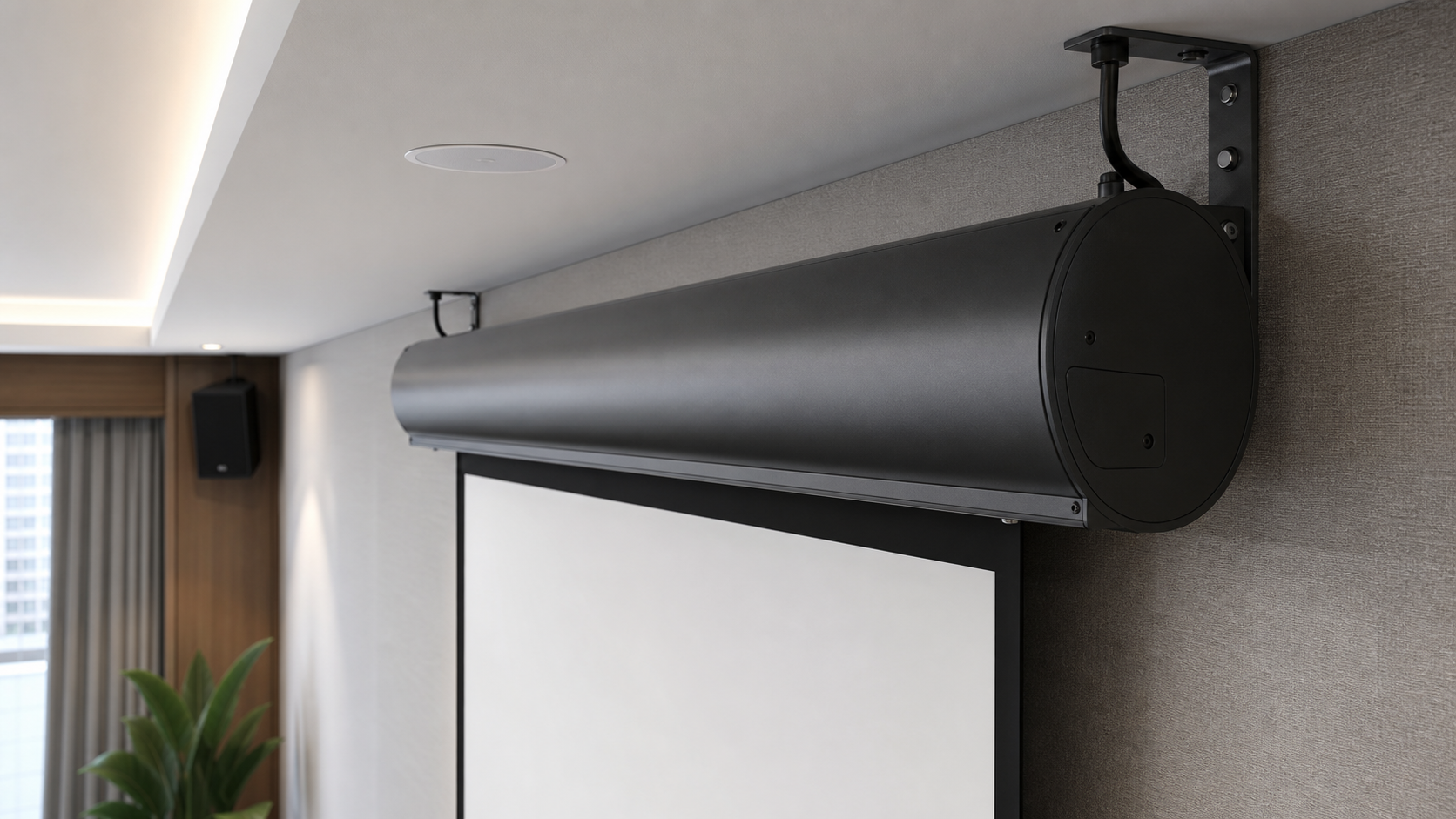
A 95mm round housing motorized screen can suit projects that prefer a cylindrical casing profile for a wall or ceiling installation. The round housing can influence the room’s visual language, but it does not by itself determine image quality, screen size or installation suitability.
For a reliable selection, confirm the visible image, fabric, projector geometry, mounting position, wiring, control and service access as one specification. This guide is written for distributors, AV integrators and project buyers preparing a product request.
Who This Guide Is For
This guide is for AV integrators, distributors, contractors and project buyers who need a documented selection and project-planning path for this topic before requesting a quotation.
Treat the Housing Label as a Starting Point
“95mm round” normally describes a housing family or casing profile. It should not be used as a complete product specification. A supplier still needs to confirm the outside dimensions, bracket arrangement, available image sizes, black border, drop, bottom bar and fabric options for the exact model.
Start with the audience view:
- What image width and height are required?
- Is the image 16:9, 16:10, 4:3 or another project ratio?
- Where will the nearest and farthest viewers sit?
- Does the screen need to retract after each presentation?
- Is the installation wall-mounted, ceiling-mounted or part of a ceiling detail?
Use the projection screen size and aspect-ratio guide before discussing the casing profile.
Round Housing vs Square Housing
The round profile is a visual and installation choice, not a performance ranking. A round casing may blend into a continuous ceiling line or provide a softer architectural appearance. A square casing may align more easily with a rectangular bulkhead or equipment package. In both cases, the bracket, cable entry and service route must be drawn for the exact product.
When comparing profiles, ask for the same information from each option: overall envelope, image range, mounting reference, fabric path, bottom-bar travel, control method and access requirement. This prevents the project from choosing an enclosure based only on a catalogue photograph.
When a Round Housing Is a Good Direction
A round housing may be considered when the casing is visible and the project values a clean cylindrical profile. It can work in a conference room, classroom, showroom or shared presentation space when the mounting surface and service access are clear.
If the room requires a concealed housing, a round external case is not automatically an in-ceiling product. Compare the in-ceiling electric projection screen family and ask whether the requested 95mm round model supports the intended recess or closure detail.
For a dedicated cinema wall where retraction is not needed, compare a fixed-frame screen as a separate direction. Product type should follow room use rather than the casing name.
Confirm the Mounting Envelope
Request the current drawing and check:
| Drawing item | Project question |
|---|---|
| Overall casing dimensions | Will it fit above the image and below the ceiling? |
| Bracket positions | Does the structure accept the fixing method? |
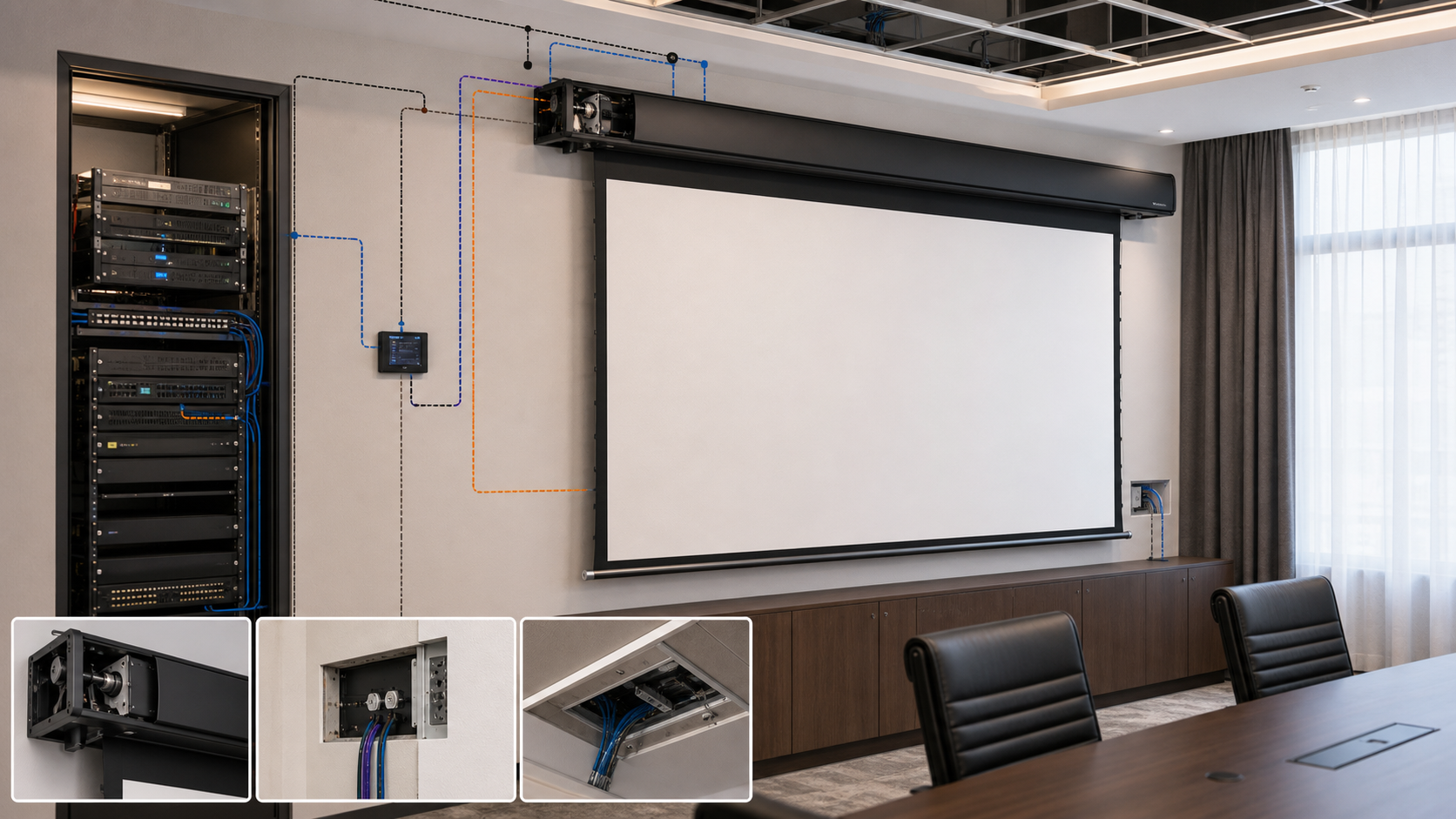
| Cable entry | Can power and control reach the housing without visible routing? |
| Fabric drop and bottom bar | Is the final image height comfortable for the seats? |
| Service access | Can the motor and control components be reached later? |
| Clearance around the casing | Will lights, sprinklers, doors or HVAC interfere? |
Do not close a ceiling or build a decorative cover until the drawing, cable route and access plan are approved. A screen that fits visually but cannot be serviced creates a project risk.
Commissioning a Round Housing Screen
After installation, check that the housing is level, the fabric path is unobstructed and the bottom bar stops at the approved position. Run the screen through the local and integrated controls, then record the final limit settings and any visible alignment issue. If the screen is installed above a conference table or teaching wall, check the image height from the actual seats rather than from the installer’s position.
For a repeated project, keep the approved round-housing drawing with the room ID, model name and control record. This makes later replacement or room expansion easier and avoids mixing a round casing specification with a different product family.
Choose the Material With the Projector
The casing does not decide the screen material. A controlled room may use a broad-viewing matte surface, while a room with daylight or bright task lighting may require an ALR discussion. ALR surfaces depend on projector position and viewing cone, so the material should be reviewed with the ALR versus matte white guide.
For a short-throw or UST projector, request the exact material recommendation and sample under the proposed projector. Check color neutrality, texture, hotspotting and off-axis viewing. Never transfer a material specification from one screen family to another without model confirmation.
Standard Electric or Tensioned Surface?
If a project needs a retractable surface, compare the standard electric and tab-tensioned options. A tensioned screen may be useful when edge control is important, but it needs adequate side clearance and must be available in the required size and material.
| Requirement | Product direction to compare | What to verify |
|---|---|---|
| General presentation | Standard electric | Surface, control and installation |
| Higher flatness expectation | Tab-tensioned electric | Tension path, offered size and side clearance |
| Hidden ceiling finish | In-ceiling electric | Rough-in, access and closure detail |
| Permanent cinema wall | Fixed frame | Wall flatness, speakers and trim |
Prepare a 95mm Round Housing RFQ
Include the visible image size, ratio, projector model, room type, ambient light, mounting method, material direction, control preference, quantity and destination. Ask for the current model drawing, wiring information, installation instructions and any project-specific sample requirements.
MGF Screens can review this information through the Contact page. Factory capabilities and inspection context can be reviewed through Factory & Production, while distributor cooperation can reference the Partner Program.
MGF Product Direction
MGF can compare suitable product directions once the project brief confirms visible image size, aspect ratio, projector geometry, material direction, mounting condition, control requirements, quantity and destination market. The final quotation should identify the exact model, compatible material, drawing and approval information rather than treating a generic guide as a product specification.
Project / OEM Checklist
- visible image width, height and aspect ratio;
- projector model, lens position and image geometry;
- room or venue use, seating and ambient-light condition;
- proposed material, structure, mounting and service access;
- power, control and installation responsibility where relevant;
- required quantity, destination market, drawing revision and approval owner.
Continue Your Project Planning
- Screen Selection Guides
- Electric Projection Screens
- Fixed Frame Projection Screens
- Conference Room Applications
- Factory & Production
- Projection Screen Size and Aspect Ratio Guide
- Contact MGF Screens
FAQ
Does a 95mm round housing guarantee a specific screen size?
No. The available image size depends on the exact model, material, roller and construction. Request the current size table.
Can a round housing be installed inside a ceiling?
Only if the exact product is designed and documented for that installation. Confirm rough-in, access and closure requirements.
Is a round housing better than a square housing?
Neither is universally better. The choice depends on visual preference, mounting conditions, service access and product availability.
Does the housing profile affect image quality?
Image quality is primarily affected by the surface, projector, geometry, flatness and room conditions. Housing selection still matters for fabric path and installation stability.
Request the Model-Specific Drawing
Send the proposed image size, room application, projector details, mounting position and control requirement to MGF Screens. Ask the supplier to confirm the round housing, material, wiring and final dimensions together.