Home Theater Projection Screen Buying Guide
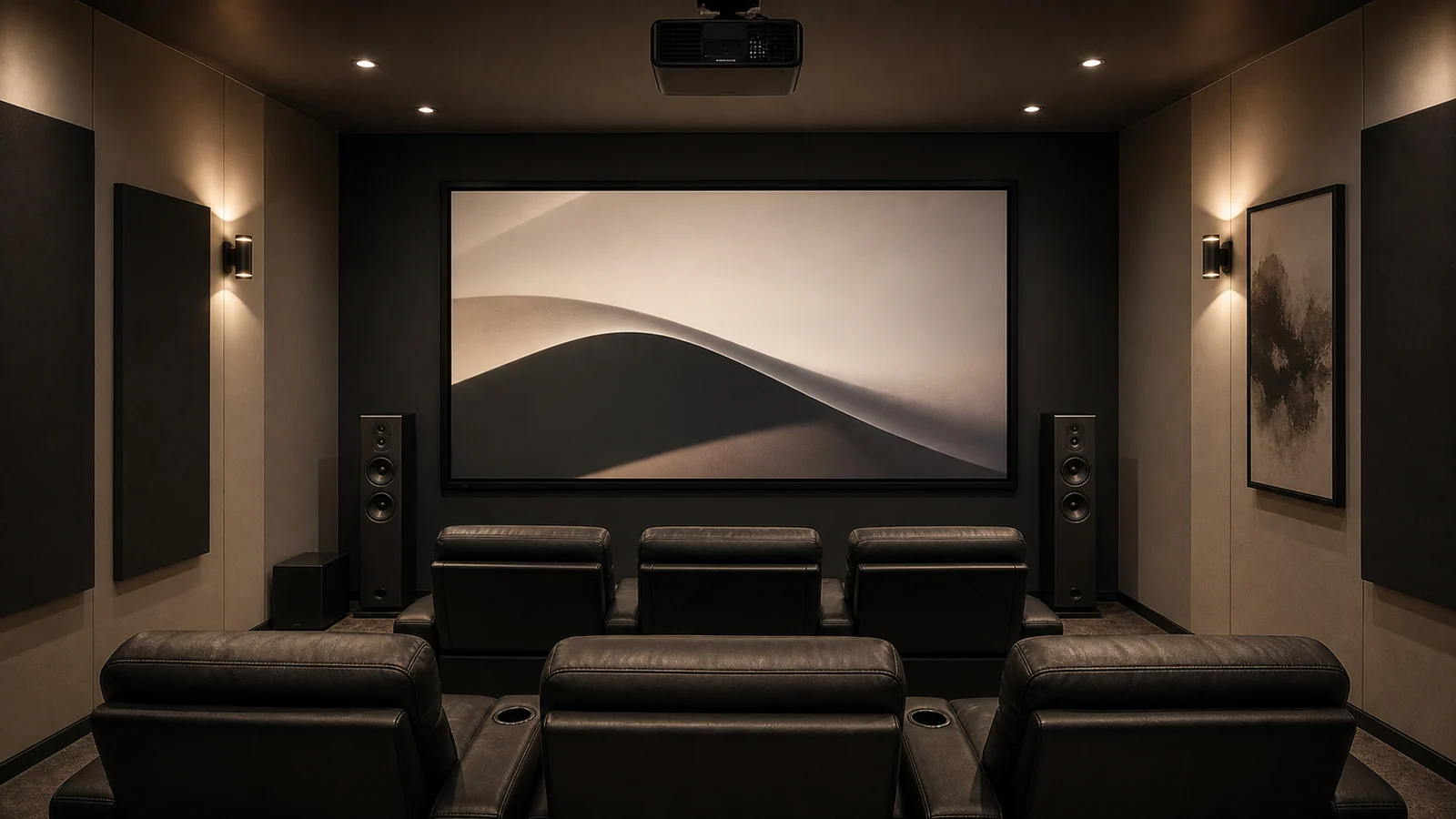
A home theater projection screen should be selected as part of the complete room—not as a white rectangle ordered after the projector. Room light, seating, image size, throw geometry, speaker placement and interior design all affect the right specification.
Use this sequence to narrow the choices and prepare a clear request for a screen supplier or AV integrator.
In This Guide
Define the Room Before the Screen
Record room width, depth, ceiling height, wall finish, windows, doors and the planned seating positions. Identify direct light that can reach the screen and decide which lights must remain on during viewing. A dedicated dark theater and a shared living room may need very different surfaces even when the image size is the same.
Also note whether the front wall is permanently available. If the screen must disappear when not in use, that requirement immediately changes the product type and installation plan.
Choose Image Size From Seats and Content
Begin with visible image dimensions and aspect ratio. Test the proposed image from the nearest and farthest seats using real movie subtitles, menus and gaming interfaces. Avoid choosing by diagonal alone: the same diagonal produces different widths at 16:9 and 2.35:1.
Then confirm the projector can create that image at the available throw distance and lens position. Our screen size and aspect-ratio guide and projector pairing guide provide the calculation workflow.
Select the Screen Type
| Requirement | Likely direction | Key verification |
|---|---|---|
| Dedicated screen wall | Fixed frame | Wall flatness, frame width and speaker plan |
| Screen hidden after viewing | Motorized or recessed | Housing space, power, controls and service access |
| High retractable flatness | Tab-tensioned motorized | Offered size, material compatibility and side clearance |
| No wall or ceiling installation | Floor-rising | Floor footprint, furniture and storage |
A fixed frame usually offers the simplest route to a stable image plane. A retractable screen protects the room design and shared-use wall, but adds mechanical, electrical and access requirements. See our focused fixed frame versus motorized home theater comparison.
Match Material to Light and Projector Geometry
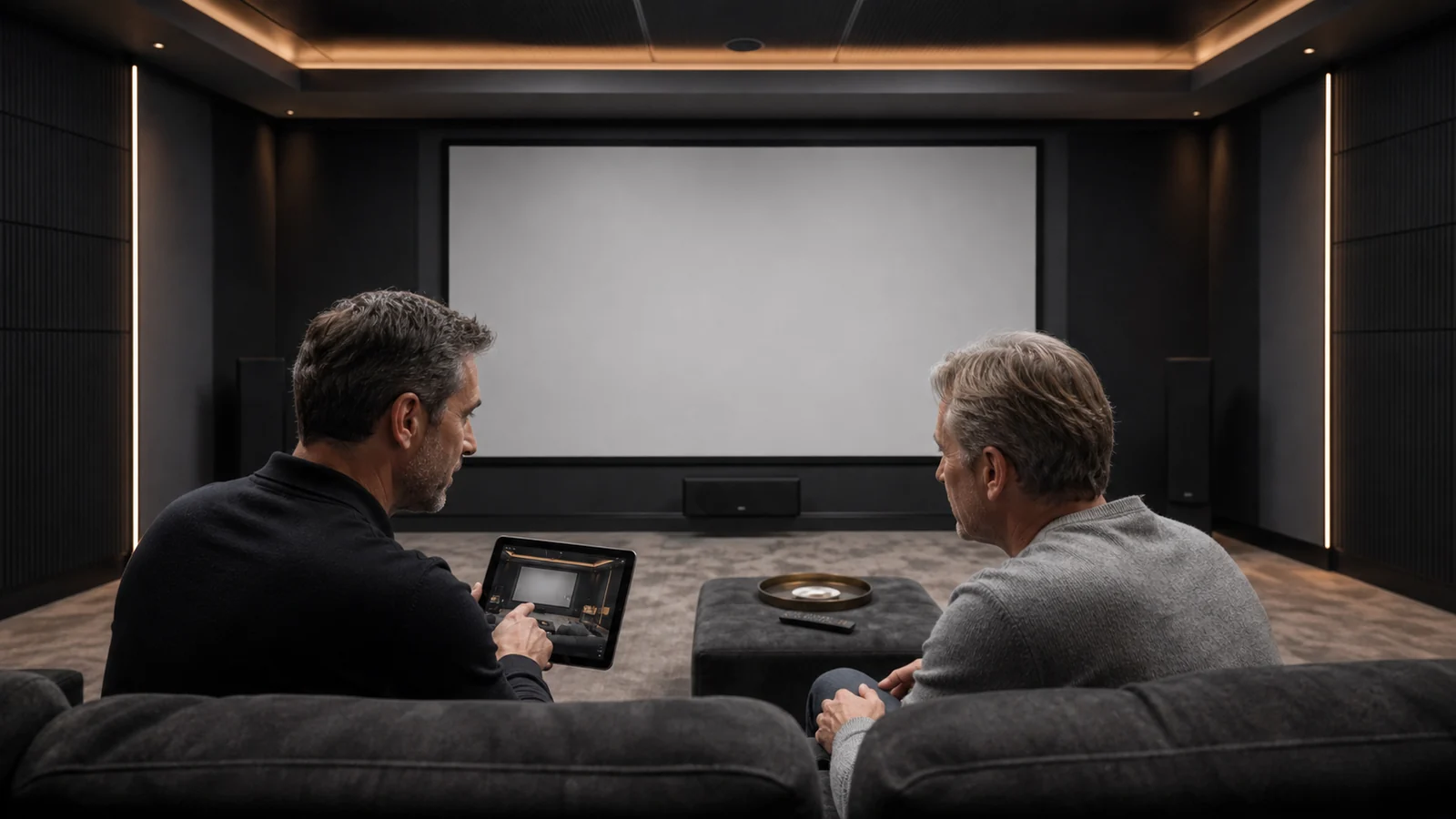
Matte white is a strong baseline in controlled light because it generally supports natural color and broad seating. Neutral grey may help perceived black level in some rooms, but it also changes the brightness budget. Read matte white versus grey screens before requesting samples.
ALR and UST/CLR materials are directional systems. They should be paired with the intended projector position and seating, not selected from the material name alone. For ultra-short-throw systems, use the ALR, CLR and UST screen guide.
Compare samples under the actual projector, room lights and seating angles. Check hotspotting, color neutrality, texture and off-axis image—not just a bright center view.
Coordinate Speakers Before Ordering
If speakers sit beside or below the image, reserve physical space and confirm that the image height remains comfortable. If the front speakers must be hidden behind the image, evaluate an acoustic transparent surface as a system with speaker distance, wall treatment and projector resolution.
Do not assume every perforated or woven surface performs the same. Review the acoustic transparent projection screen guide and approve a sample with both image and sound tests.
Plan Installation and Control
For a fixed frame, confirm wall structure, mounting position and assembly clearance. For motorized products, coordinate power, control wiring, housing dimensions, ceiling recess, bottom-bar position and future service access before finishes close.
Record the desired control method—RF, IR, trigger, dry contact or building-control integration—but verify compatibility for the exact model. Never conceal an enclosure without a documented access route.
Prepare a Purchase Specification
Send the supplier:
- visible image width, height and aspect ratio;
- projector model and planned lens position;
- room light and seating information;
- screen type and mounting preference;
- proposed material or sample-test request;
- speaker arrangement and acoustic requirement;
- power, control and finish requirements;
- delivery location, access constraints and target date.
This information allows the supplier to confirm compatibility instead of guessing from a diagonal size.
FAQ
What is the best projection screen for a dedicated home theater?
A fixed frame with a surface matched to the projector and controlled room is a common direction. The final choice depends on seating, speakers, image size and sample testing.
Is an ALR screen necessary in a home theater?
Not automatically. Light control may be more valuable in a dark theater. Consider ALR when room-light conditions and projector geometry justify it, then test the viewing cone.
Should I choose 16:9 or 2.35:1?
Choose from the content mix, projector capabilities and preferred image-management method. Confirm how menus, subtitles and mixed-aspect content will be displayed.
Can speakers go behind the screen?
Yes, with a compatible acoustic transparent surface and a coordinated speaker-wall design. Image texture, light output and acoustic performance should be approved together.
Is a tab-tensioned screen better than a standard motorized screen?
Tab tension can improve edge control and flatness, but offered size, material, cost and installation clearance must be checked for the exact product.
Plan Your Home Theater Screen With MGF Screens
Send MGF Screens your room dimensions, seating plan, projector model, image size, light conditions and speaker layout. We can help identify a suitable product direction and the details that require sample or technical confirmation.
---