How to Choose a Motorized Projection Screen Manufacturer
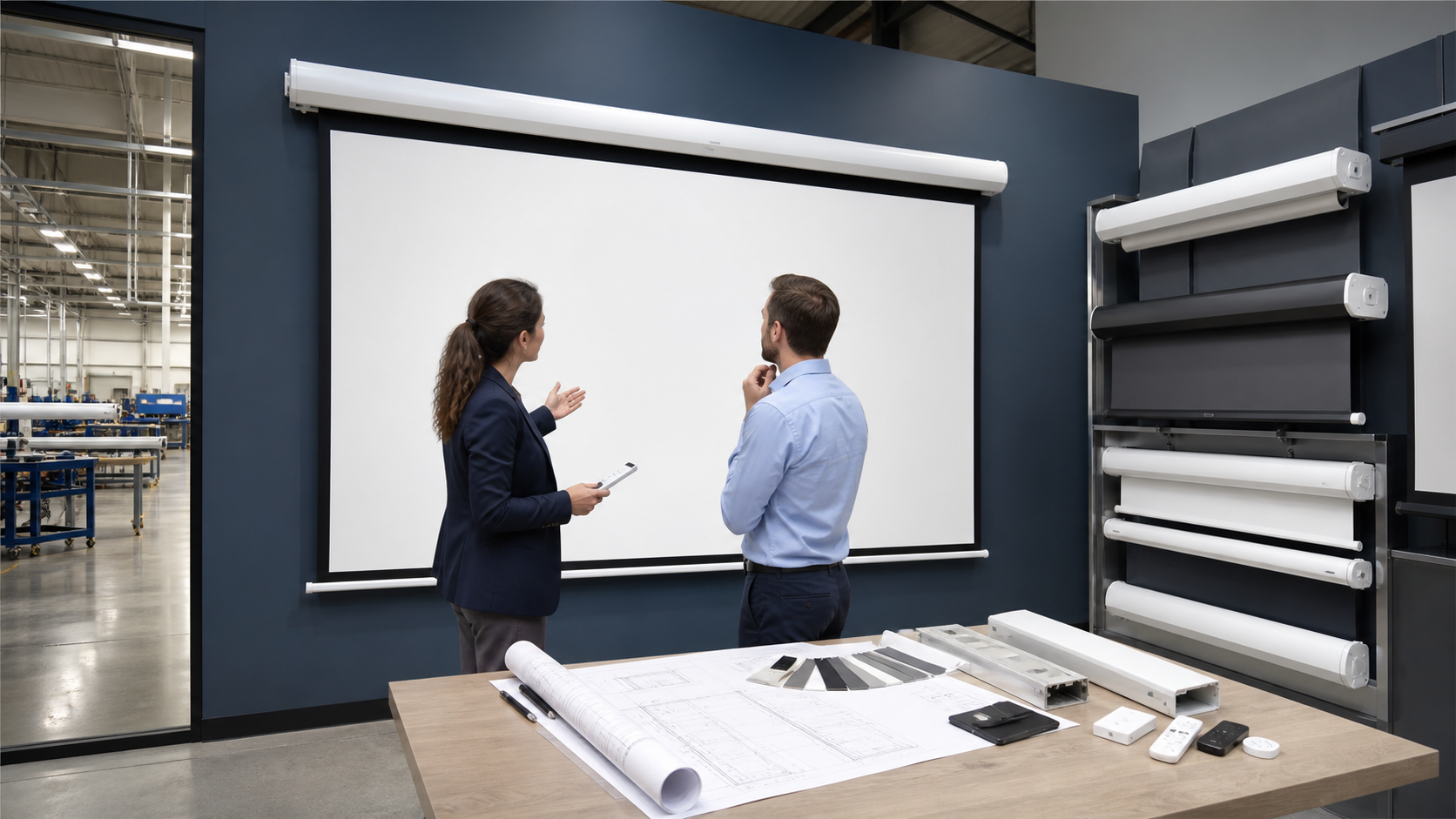
A product-specific manufacturer evaluation guide covering motorized screen structure, electrical/control scope, samples, QC, documents and repeat-order support.
In This Guide
Quick answer
Choose a motorized projection screen manufacturer by verifying more than catalog range. A capable supplier should explain product structure, screen material, installation, motor and control options, sample approval, quality inspection, packaging and document traceability for the exact configuration you plan to sell or install.
Start with your application and channel requirements, then compare factories using the same evidence checklist. A supplier that asks for missing project information is usually easier to evaluate than one that quotes without clarifying scope.
Manufacturer selection scorecard
| Area | Questions to ask | Evidence |
|---|---|---|
| Product fit | Which electric and tab-tension families match the project? | Product matrix |
| Engineering | Can the supplier review dimensions, mounting and controls? | Drawing/sample process |
| Material | Can it provide samples for the projector and room? | Labeled samples |
| Control | Which remote, trigger, dry contact or serial options apply? | Model-specific confirmation |
| Quality | What is checked before shipment? | QC records |
| Packaging | How are long housings and frames protected? | Packing specification |
| Compliance | Which documents apply to the model and market? | Current documents |
| Repeatability | Can the approved configuration be reproduced? | Traceability records |
1. Define the target motorized screen
Specify application, visible image size, aspect ratio, material direction, installation method, destination voltage, control expectation, quantity and destination market. Compare standard electric screens with in-ceiling tab-tension screens only after the installation and surface requirements are clear.
This page evaluates the motor, housing, electrical/control and commissioning scope of motorized products. For a broader supplier-management review covering company structure, export process and general OEM controls, use the OEM manufacturer evaluation guide.
2. Verify manufacturing and engineering capability
Review how the supplier handles fabric preparation, housing or frame assembly, motor installation, wiring, functional testing, inspection and packing. The factory production page can introduce the manufacturing context, but project buyers should still request current model-specific documents.
Ask for a drawing or specification showing image area, housing, black border, drop, brackets, cable entry, service clearance and control method. The approval should carry a revision number.
3. Confirm control and electrical scope
Motorized screens can be operated by remote, wall switch or an integrated AV system. Ask the manufacturer to confirm which control components and terminals are included for the exact model. Never assume that one interface or destination voltage applies to every product family.
Use the motorized screen control integration guide to organize protocol, wiring, responsibility and submittal questions.
4. Use a representative sample
The sample should match the intended material, housing, motor, controls, accessories and packaging. Test deployment, retraction, stop positions, surface quality, labels and unboxing. Record deviations and require a controlled correction before mass production.
5. Review QC and traceability
Ask how incoming components, dimensions, surface, motor, limits, accessories, labels and packaging are checked. Link the approved sample to the order, drawing and inspection record through the OEM ordering and document-control guide.
6. Evaluate market and repeat-order support
For distributors, verify private-label options, packaging, document language, spare-parts route and repeat-order handling. For integrators, verify drawing turnaround, installation information and response to field issues. Review the OEM partner program when building a longer-term supply relationship.
FAQ
Is a large catalog proof that a manufacturer is suitable?
No. The supplier must show that the relevant product, material, controls, documents and QC process apply to your exact configuration.
Should I choose a factory or a trading company?
Either model can work if responsibilities and evidence are clear. Confirm who controls engineering, production, inspection, packaging and after-sales decisions.
What is the most important sample test?
Use the real material, projector and control expectations where possible. Check the complete delivered configuration instead of viewing a housing photo only.
When should I request compliance documents?
During technical evaluation and before order approval. Confirm model-level applicability for the destination market.
Review MGF Manufacturing Evidence
MGF workshop photos and video frames show fabric cutting, spraying, assembly areas, screen deployment and packing. Use the factory overview to review these activities and the document register to check historical report scope.
For your selected screen, request the approved drawing and BOM revision, batch inspection records, packing dimensions and model-matched documents. Confirm available records, production capacity and delivery timing for the order.
Request a manufacturer evaluation pack
Share your application, model family, size, material, controls, quantity and destination through Request a manufacturer evaluation pack. MGF can confirm which options and documents apply to the quoted configuration.