Fixed Frame Projection Screen OEM Options for Distributors
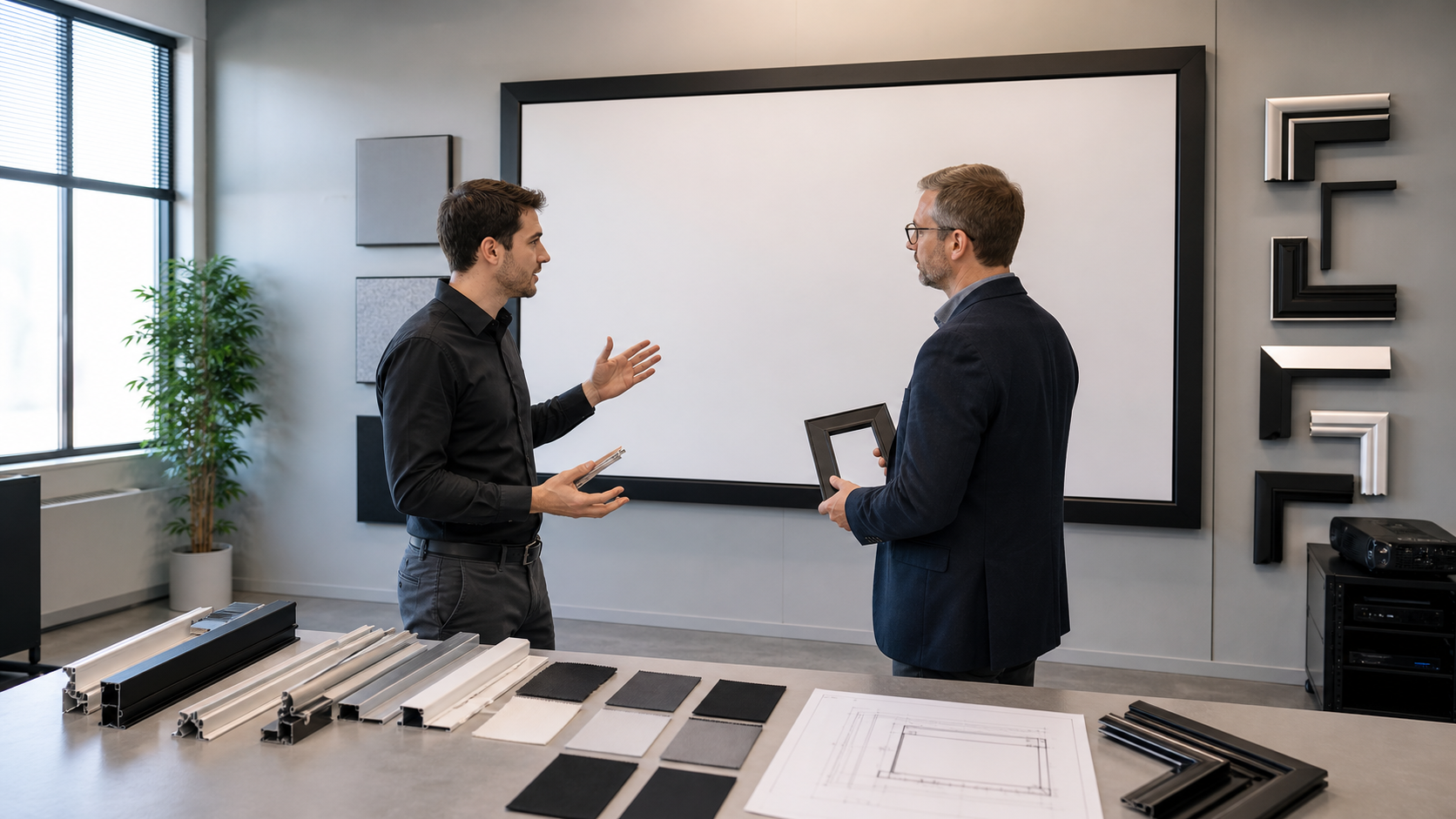
A sourcing guide for distributors comparing fixed-frame profiles, image dimensions, surfaces, branding, samples, documents and packaging.
In This Guide
Quick answer
Fixed frame projection screen OEM projects should define more than diagonal size. Distributors need to confirm visible image dimensions, aspect ratio, frame profile, border, surface, acoustic or standard construction, wall-mount method, finish, accessories, branding, packaging and technical documents.
The right OEM option depends on the channel: home theater, commercial display, education, showroom or large venue. Use a controlled option matrix so every quoted configuration remains installable and repeatable.
Who This Guide Is For
This guide is for distributors building a repeatable fixed-frame range, AV integrators sourcing a project configuration and private-label buyers aligning samples with future replenishment. It focuses on the commercial and approval options behind an OEM order. Buyers who are still deciding whether the room needs a permanent frame or a retractable product should first compare fixed-frame and motorized screen directions.
Prepare one option sheet per SKU rather than combining every profile, surface and aspect ratio into a generic family. That makes artwork, drawings, packaging and inspection evidence easier to trace.
Fixed-frame OEM option matrix
| Option | Buyer decision | Confirmation needed |
|---|---|---|
| Image | Width, height, ratio and border | Approved dimensions |
| Frame | Standard, full-screen, narrow-bezel or curved | Profile and joint detail |
| Surface | Matte, grey, ALR, acoustic or other | Sample and compatibility |
| Mounting | Wall, cleat, bracket or project-specific | Drawing and hardware |
| Finish | Color, texture and visible edge | Sample/proof |
| Branding | Label, frame mark, manual and carton | Artwork revision |
| Packing | Carton, pallet, crate and protection | Packing plan |
| Documents | Drawing, spec, installation and QC | Controlled file list |
1. Match frame design to the application
Use the fixed-frame product category to compare standard and project-specific options. Home theater buyers may prioritize border appearance and acoustic placement; commercial projects may prioritize repeatable dimensions, service documentation and shipment protection.
Do not use a fixed frame where the project requires the screen to retract or disappear. Confirm the wall condition, viewing height and required service access before choosing the structure.
2. Define image and frame dimensions separately
Record visible image width and height, aspect ratio, black border or masking, overall frame size, mounting points and wall clearances. Link the dimensions to the screen size guide and the 65 mm vs 87 mm frame comparison.
“120-inch fixed frame” is not a complete OEM specification. Two frames can have the same diagonal while using different ratios, borders, profiles and overall dimensions.
3. Choose the surface after projector review
Specify projector type, throw direction, ambient light, seating layout and acoustic requirements. For an acoustic-transparent design, review speaker position and material visibility at the intended distance. For ALR or special surfaces, request a labeled sample and confirmation of compatible projection geometry.
The Screen Materials Hub provides the material-selection path; do not add unconfirmed optical figures to an OEM quote.
4. Decide the OEM branding scope
List logo position, frame finish, model label, manual, carton artwork, barcode and accessory presentation. Separate standard components from custom work. Approve proofs with a revision number before production.
5. Require a drawing and sample
The technical package should show image area, frame profile, joints, tension method, brackets, overall dimensions and packaging assumptions. Approve a representative sample before mass production when the frame, surface, dimensions or branding are new.
6. Align QC and installation documents
Ask how frame squareness, corner joints, surface condition, dimensions, hardware, labels and packaging are checked. Provide the installer with the approved drawing and hardware list. Connect the project to OEM Quality Control and Technical Submittals.
FAQ
Can a fixed frame be made in any ratio?
The available ratio and size depend on the selected design, material and production capability. Request model-specific confirmation rather than assuming every combination is standard.
Should a distributor offer both standard and narrow-bezel frames?
That depends on the channel and buyer demand. Use separate SKUs and clear dimensions so the options do not become interchangeable in a quotation.
Is an acoustic-transparent frame always better for home theater?
Only when the audio layout, material behavior and viewing distance support it. Compare the complete system rather than the frame name alone.
What should be approved before a private-label order?
Approve the product sample, frame/profile drawing, surface, artwork, manual, carton, accessories and QC criteria.
Request fixed-frame OEM options
Send your target size, ratio, material, frame direction, application, quantity, branding and destination through MGF OEM/ODM Solutions or Contact.