Large Venue Projection Screen Supplier Selection Guide
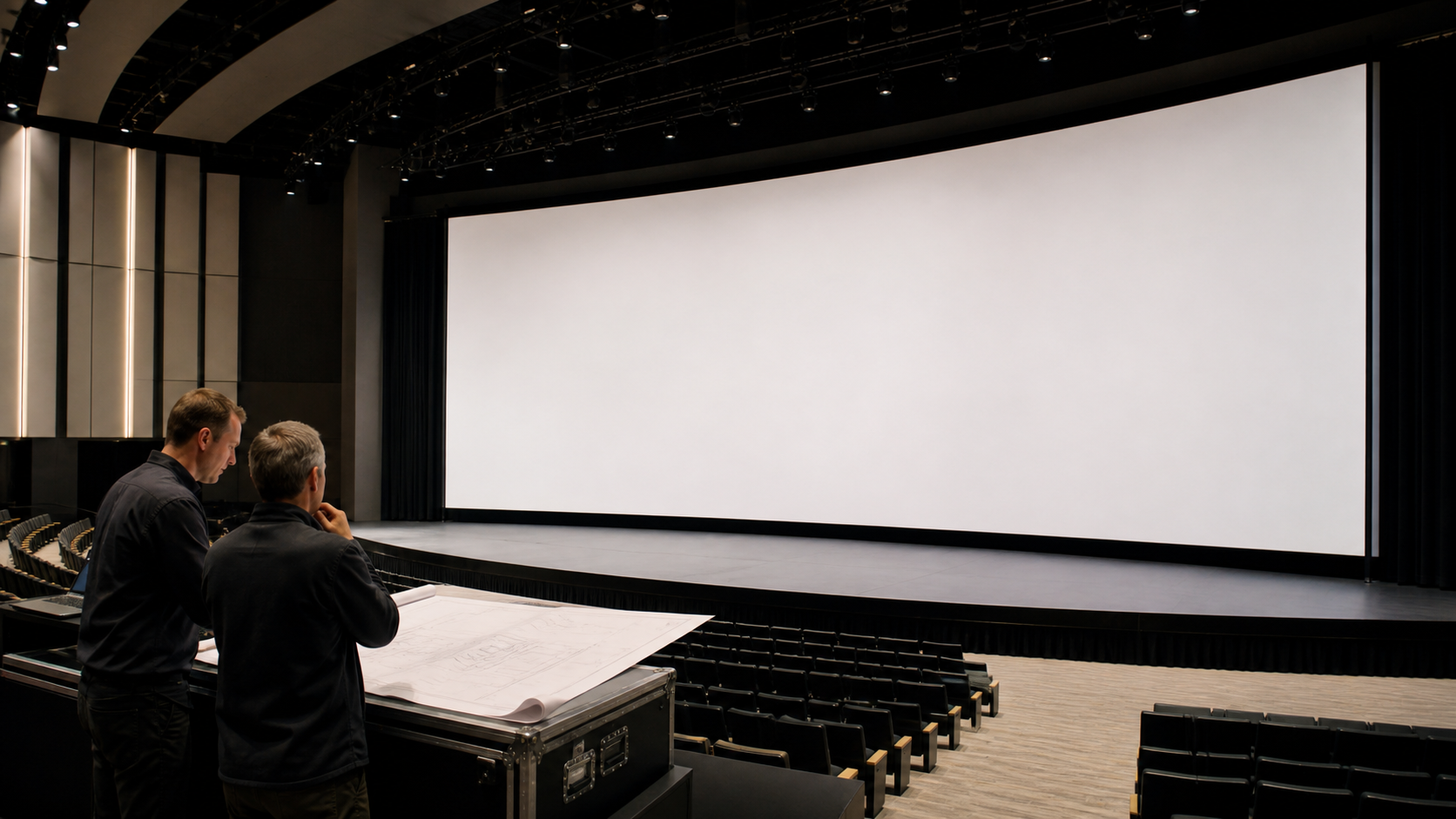
A supplier-evaluation guide for auditorium and large-venue buyers coordinating screen geometry, engineering, materials, installation, QC and logistics.
In This Guide
Quick answer
Selecting a large venue projection screen supplier requires more than comparing a quoted width. Buyers should evaluate venue geometry, screen structure, flatness, surface, acoustic or standard construction, installation method, engineering documents, quality control, packing, site support and communication process.
Start with the large curved fixed-frame projection screen when the venue needs a large, stable viewing surface. Then request a supplier-specific drawing and project review before the screen is released for production.
Supplier evaluation matrix
| Evaluation area | Questions to ask | Evidence to request |
|---|---|---|
| Project fit | Has the supplier reviewed venue geometry and sightlines? | Project brief and marked-up drawing |
| Structure | How are frame joints, supports and curvature defined? | Assembly and installation drawings |
| Surface | Is the material compatible with the projector and seating? | Labeled sample and compatibility notes |
| Acoustic layout | Can speakers be placed behind the surface if required? | Acoustic layout and material confirmation |
| Engineering | Are dimensions, interfaces and tolerances documented? | Controlled submittal package |
| QC | How are flatness, joints, surface and packaging checked? | Inspection checklist and records |
| Logistics | How is the screen protected and identified in transit? | Packing plan and itemized list |
| Project support | Who handles questions, approvals and site issues? | Named contact and escalation path |
1. Confirm the venue application
Record the venue type, audience size, seating layout, projector position, sightline constraints, screen location and installation sequence. Auditoriums, cinemas, houses of worship, museums and event spaces can have very different requirements.
Use the church and auditorium projection screen guide to prepare room, sightline, audio and installation inputs before supplier evaluation.
For an event or touring application, compare the portable and fast-fold options instead of treating a permanent frame as the default. For a permanent venue installation, define the support structure and service access before requesting a final quote.
2. Decide between flat and curved construction
A curved screen may support a specific venue geometry or visual design, but the curve, frame joints, support points and projection alignment must be engineered as one system. Ask the supplier to show the curve and installation reference in the drawing.
The curved fixed-frame planning guide covers the geometry and coordination questions that should appear in the supplier brief.
Do not compare a curved screen and a flat screen only by width and price. Compare the complete structure, projection conditions, transport method, installation labor and future replacement path.
3. Specify the visible image and border
Define visible image width and height, aspect ratio, border or masking, overall frame dimensions, support points and wall or rigging clearances. If the project uses a custom ratio, include a dimensioned elevation in the RFQ.
The screen size and aspect ratio guide can help the buyer prepare the brief. The supplier should still confirm the final dimensions for the selected model and surface.
4. Select the surface for projector and seating conditions
Review projector type, throw direction, brightness distribution, ambient light and seating angles. A matte surface can provide a broad viewing angle in a controlled venue; an ALR or specialty surface may require stricter projection geometry. An acoustic-transparent surface should be reviewed together with speaker placement and expected viewing distance.
Ask for a labeled material sample and record the sample revision in the quotation. Use the Screen Materials Hub to organize this decision, but avoid publishing optical performance claims that have not been verified for the exact material.
5. Review engineering and installation support
Require an approved drawing that shows frame profiles, joints, support points, screen surface, overall dimensions, mounting method and service clearances. For a large venue, ask who is responsible for rigging or wall reinforcement and which information must be supplied by the local contractor.
The supplier should provide an installation sequence, hardware list and inspection points. Link the project to Technical Submittals and installation-method planning.
6. Audit QC and project communication
Ask how the factory checks frame squareness, joint alignment, surface condition, dimensions, labels and packing. Establish approval gates for the drawing, material sample, first article, pre-shipment inspection and delivery record.
Evidence of a documented factory production process, quality-control checklist and certifications helps the buyer evaluate process maturity. The evidence should relate to the actual product and project scope.
7. Compare the total project cost
Compare the same scope: screen surface, frame and supports, accessories, packing, documents, inspection, freight assumptions and after-sales responsibilities. A lower screen-only price may exclude engineering or site requirements that later become change orders.
Use a bid-comparison sheet with one row per requirement and record exceptions. Ask the supplier to identify standard items, optional items and custom items separately.
FAQ
What is the most important supplier qualification for a large venue screen?
The supplier should be able to review the venue application, provide a controlled engineering package and explain how the screen will be manufactured, packed and inspected.
Should a large venue screen always be curved?
No. Curvature depends on the venue, projector arrangement, visual requirements and structural design. Select it only after a project review.
What documents should be included in the RFQ?
Include a dimensioned elevation, venue photos or drawings, projector information, seating layout, surface preference, installation constraints, quantity, destination and required approval dates.
How can a buyer compare two supplier quotations fairly?
Normalize the visible image size, structure, surface, supports, documents, inspection, packing and delivery assumptions before comparing price.
Request a large venue supplier review
Send the venue type, image dimensions, projector information, seating layout, surface preference, installation method, quantity and delivery location through MGF OEM/ODM Solutions or Contact.